Muna'fi'qeen: Imposter believers—the Narcissist in the society of believers of exalted last Messenger Muhammad Sal'lallaa'hoalaih'wa'salam
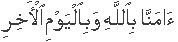

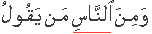
Be aware of such persons affiliated with the set of people (in those days Jews) who proclaim;
"We have accepted the belief in Allah the Exalted and the Last Day.";
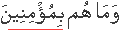
But the position is that in truth and entailment they are certainly not the believers. [2:08]

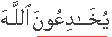
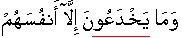


They seek by contrary to fact verbal assertion to beguile Allah the Exalted and to convince those who have accepted consciously and truly [the Messenger and Grand Qur'aan].
However, in fact they deceive none by false declaration of belief except their own selves;
Meanwhile they analyze not to realize-perceive this fact [since do not see beyond their selfish stakes]. [2:09]




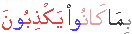
Irrational beliefs - a disease - psychological disorder - envy, jealousy, and malice, bias, rancour is self implanted- nurtured within their hearts- locus of understanding - consciousness;
Thereby, it being their willful act, Allah the Exalted has let them overwhelm, with regard to their respective disease [by leaving them as condemned- discarded].
Beware; a severe punishment is in wait- prepared for them;
This upshot is because they kept publicly lying by deceptive proclamations of belief. [2:10]

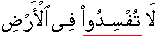



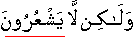
Know further about them, when it was said to them:
"You people should not purposely cause disorder - imbalance - distortions - spread wicked and unsound conjectural ideas in the society"—
They replied, claiming: "We are only-really the perfectionists". [2:11]
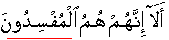
Beware; the fact is that they are truly the distorters- creators of disorder-imbalances- spreaders of wicked unsound ideas—
While they intend not to recognize it. [2:12]
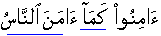



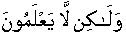
Moreover, when it was said to them, Muna'fi'qeen: Imposter believers,
"You people incline to accept likewise as other people have heartily accepted."—
They replied: "Should we accept likewise as the Fools have accepted?"
No, the fact is that they
themselves are truly
the Fools [ ]—
]—
Since they aspire not gaining knowledge [under duality of thought to retain association with Non-believing Jews]. [2:13]
.gif)






Be informed: when they confronted those who had truly believed [whom they regarded fools on their back]; they said to them: "We have accepted- believed".
However, while they went in privacy with their people/bosses of devilish psyche and conduct, they said to them clarifying:
"Certainly, We are affiliated with you people. We only contrive jesting with them, the believers." [2:14]
[These fools do not understand that] Allah the Exalted by will and design keeps ignoring- discarding them.
Moreover, He the Exalted lets them prolonging in their defiant brims, leaving them in state of blind distracted wandering (in company of their brothers, evil-doers Refer 7:202) [2:15]

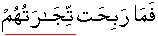

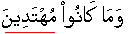
The aforementioned are the people who have purposely purchased the vagrancy - straying exchanging with the Guidance - Grand Qur'aan.
Thereby, their "Instant Commerce" did not yield benefit.
It retained them in a state of those who incline not to become guided aright. [2:16]





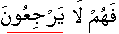
The semblance - illustration of them/Muna'fi'qeen is like the illustration of a person who sincerely kindled a fire;
Thereat when the purpose was achieved—it the kindled fire had illuminated all that present around him—
Allah the Exalted took-faded away their faculty of observing white-light—
And He the Exalted discarded them/Muna'fi'qeen as self engulfed in layers of darkness; they are in mindset of observing and perceiving not. [2:17]
These Muna'fi'qeen: imposter believers act like a deaf, dumb, blind.
Resultantly, they revert not to guidance. [2:18]
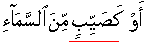



Or alternatively, semblance - illustration of them/Muna'fi'qeen is like the illustration of: صَيِّبٍ [Hyperbolic-Intensive participle] Supercell thunderstorm that has suddenly overtaken-descended from the Sky.
Layers of darkness and activity of excited movements, and luminosity-lightening keep happening within [him-صَيِّبٍ] Supercell thunderstorm.
They insert their fingers in their Ears on hearing stunning thunder-clap to guard fear of the death.
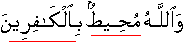
Know it; Allah the Exalted is all-encompassing those who are deniers - non-believing. [2:19]





The lightening might soon blur - obscure their vision faculty.
Whenever lightening caused illuminating flash for them, they walked therein; and when it caused darkening effect upon them they stopped stand still.
However, had Allah the Exalted so decided, He would have taken away their faculty of hearing and visions.
It is a fact that Allah the Exalted is eternally the Causality Determiner upon every and all things. [2:20]
Coherence:
This is linear - instant
response to the individual who prayed to Allah the exalted for providing
continued guidance
upon the High road that keeps leading
safely and stably to the destination of peace and tranquility-Ayah 1:7.
He is advised to frequent the Grand Qur'aan for taking guidance from it
in every matter for aright course of action and conduct. And out of the
three categories of people he had mentioned, third are described who are
wanderers:
 .
.
Ayahs 8-20:
 →
→ comprise of 193 separate words. It is like
a paragraph in English language that is around seven to ten sentences
long. The paragraph
form refers to its
overall structure, which is a group of sentences focusing on a single
topic.
comprise of 193 separate words. It is like
a paragraph in English language that is around seven to ten sentences
long. The paragraph
form refers to its
overall structure, which is a group of sentences focusing on a single
topic.
There are three main parts of a paragraph:
The paragraph unity is maintained when every other sentence would give specific information than the topic sentence that maintains the same focus of attention as the topic sentence.
Concept—theme:
The text of paragraph is expository:
a type of informational text that provides factual
information about a topic using a clear, non-narrative organizational
structure with a major topic and supporting information.
It is written
in a way that doesn't assume that the reader has
prior knowledge of the subject matter. It is used to explain things
rather than argue a point. Here
it describes people who are termed in the
discipline of Psychology as "Narcissists". It is a personality disorder.
A critical reader will find that the Grand Qur'aan classifies and
portrays people by their psychology and assigns them a typical name-term
for identification. Like a superb coherent paragraph,
it discloses in ascending order the characteristic features of
the Narcissist in the society of believers of
exalted last Messenger Muhammad
Sal'lallaa'hoalaih'wa'salam . The first is that they are Imposter Believers: Introduction of a peculiar class of
people belonging exclusively to the Believer's society:
 ,
"the Narcissist"
and they are the wanderers:
the second category of people who do not follow:
,
"the Narcissist"
and they are the wanderers:
the second category of people who do not follow:

 as
stated in 1:6-7. The paragraph will close by exemplifying these people
with natural phenomenon that images their inner-self to facilitate the
believers recognizing them.
as
stated in 1:6-7. The paragraph will close by exemplifying these people
with natural phenomenon that images their inner-self to facilitate the
believers recognizing them.
Be aware of such persons affiliated with the set of people (in those days Jews) who proclaim;
"We have accepted the belief in Allah the Exalted and the Last Day";
But the position is that in truth and entailment they are certainly not the believers. [2:08]
This is the topic
sentence of the paragraph. It is an inverted
nominal sentence with a recommencing/conjunction particle - a course
coordinator. Prepositional phrase:
 relates
to elided fronted predicate. The prepositional phrase signifies the
presence of a sub-set—certain
group of people in the society. The delayed Subject is Relative Pronoun:
relates
to elided fronted predicate. The prepositional phrase signifies the
presence of a sub-set—certain
group of people in the society. The delayed Subject is Relative Pronoun:
 "he who", and its relative clause is verbal sentence:
 "he says, proclaims before others". Its hidden subject pronoun
links to the Relative Pronoun. What he says is called: مقول
القول
and the expression is the direct object of the verb:
"We have accepted the belief in Allah the
Exalted and the Last Day".
The factual position of their claim is exposed by the following
circumstantial clause which is a nominal sentence with negation particle:
"he says, proclaims before others". Its hidden subject pronoun
links to the Relative Pronoun. What he says is called: مقول
القول
and the expression is the direct object of the verb:
"We have accepted the belief in Allah the
Exalted and the Last Day".
The factual position of their claim is exposed by the following
circumstantial clause which is a nominal sentence with negation particle:
 which
is called "The one that Resembles
ليس:
stated as:
[المشبهة بـ"ليس"]—But the position is that in
truth and entailment they are certainly not the believers.
which
is called "The one that Resembles
ليس:
stated as:
[المشبهة بـ"ليس"]—But the position is that in
truth and entailment they are certainly not the believers.
: The prepositional phrase signifies
for we the readers located
within the twenty-first century a reference about the
presence of a sub-set—certain
group of people in the society.
But who were they in the
seventh-century audience of Grand Qur'aan? The people living in those
days in Madina were divided into three sub-set with distinct identities;
firstly the emigrant believers who had migrated from Mecca, secondly
Anssar the original residents of Madina who provided help and shelter to
the emigrant believers, and thirdly the People of Book comprising of
Jews and those who named themselves as Nisara (Christians in common
parlance). Which was the sub-set referred by this phrase? Obviously, the
first two were not its referent because about them the information we
have:





Know the fact about the forerunners who took the lead-precedence in believing amongst the immigrants and the local accommodators-helpers; and those who affectionately followed their footsteps appropriately in decent manner:
Allah the Exalted has appreciated and approved them; and they are admiringly happy with Allah the Exalted.
And He the Exalted has prepared for them:
Gardens with canals of water flowing side by wherein they shall reside perpetually.
This approval and appreciation of Allah the Exalted is the grand achievement/success. [9:100]
We are left with the third sub-set of people of Madina of seventh-century, the Jews and Christians. It is later clarified that the earliest Muna'fi'qeen were people of the segment of society identified as Jews. There were not a single Muna'fiq in Mecca since no one proclaims allegiance and belief to please or deceive a people who have no authority and power in the society. Similarly there was no Munafiq from amongst the Christians.
Narcissism is a personality disorder. Psychologists say that hypocrisy is just as essential to a narcissist's functioning as a horse is to carriage's. The Free Dictionary lists the following as definitions of "hypocrisy": The practice of professing beliefs, feelings, or virtues that one does not hold or possess; falseness. The practice of professing standards, beliefs, etc., contrary to one's real character or actual behaviour, especially the pretence of virtue and piety; the condition of a person pretending to be something he is not, especially in the area of morals or religion; a false presentation of belief or feeling. Insincerity by virtue of pretending to have qualities or beliefs that one does not really have. Like denial, not everyone who engages in hypocrisy is a narcissist, but all narcissists are hypocrites. It comes with the personality disorder.
The topic sentence
describes that they pretend by professing belief what they are not,
i.e., the Believers. This in English is equivalent to "hypocrisy"—it
is just one feature not sum of their personality—therefore it does not
encompass them and thus is not the translation of term:
. The subsequent
sentences provide the details that relate to the people mentioned in the
topic sentence. Why do they make a false statement professing to be what
they are not in reality? It is clarified:
They seek by contrary to fact verbal assertion to beguile Allah the Exalted and to convince those who have accepted consciously and truly [the Messenger and Grand Qur'aan].
However, in fact they deceive none by false declaration of belief except their own selves.
Meanwhile they analyze not to realize-perceive this fact [since do not see beyond their selfish stakes]. [2:09]
—A
complete verbal sentence—Verb-Subject-Object, the subject refers to the
people who claim to be believers—"They seek
by contrary to fact verbal
assertion to beguile Allah the
Exalted".
This verbal sentence occurs only twice and by later occurrence we get the specific term-name that describes this particular class of people in the society of believers:

Indeed the Muna'fi'qeen: Imposter Believers seek by contrary to fact verbal proclamation to beguile Allah the Exalted; [refer 4:142]
 :
Verb: Imperfect; Third person; masculine; plural ; Mood: Indicative; [Form III];
[و]
Subject Pronoun, in nominative state; مصدر مُخَادَعَةٌ
Verbal Noun. Its Root is: خ د ع. According to
classical lexicons its basic perception is to proclaim, express, show
something which is contrary to what one conceals in his heart. In
consideration of objective of such volitional act, it connotes to
deceive, delude, beguile, circumvent others. In positive sense it will
denote to outwit someone. ((لسان العرب)
الخَدْعُ:
إظهار خلاف ما تُخْفيه). Form-III verb
imparts conative meanings—"an
act of attempting". Another object of their act are:
—and
to convince those
who have accepted consciously and truly
[the Messenger and Grand
Qur'aan].
:
Verb: Imperfect; Third person; masculine; plural ; Mood: Indicative; [Form III];
[و]
Subject Pronoun, in nominative state; مصدر مُخَادَعَةٌ
Verbal Noun. Its Root is: خ د ع. According to
classical lexicons its basic perception is to proclaim, express, show
something which is contrary to what one conceals in his heart. In
consideration of objective of such volitional act, it connotes to
deceive, delude, beguile, circumvent others. In positive sense it will
denote to outwit someone. ((لسان العرب)
الخَدْعُ:
إظهار خلاف ما تُخْفيه). Form-III verb
imparts conative meanings—"an
act of attempting". Another object of their act are:
—and
to convince those
who have accepted consciously and truly
[the Messenger and Grand
Qur'aan].
This characteristic act is reflective of their deceptive and coward nature. They use this considering it a protective shield:

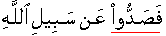
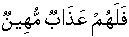
These Muna'fi'qeen have consciously and purposely adopted their declarations [of believing in Allah and the last Day and saying that Muhammad Sal'lallaa'hoalaih'wa'salam is the Messenger of Allah, in believer's society] as protective shield/deception;
Thereat with this deceptive umbrella they obstruct/repulse people off the High road of Allah the Exalted.
Thereby, disgraceful torment is in wait—prepared for them [on the Day of Resurrection].. [58:16]
This is what is their desire and intentions. But the reality is absolutely opposite to it:
However, in fact they deceive none by false declaration of belief except their own selves. Meanwhile they analyze not to realize-perceive this fact [since do not see beyond their selfish stakes]
Living a life of hypocrisy requires an extraordinary ability to deceive oneself. Narcissists have a bugaboo—a source of fear or annoyance: something that causes fear, annoyance, apprehension of loss, especially an imagined threat or problem. A narcissist is a duplicitous— two-faced who engages in double-dealing. This requires a strong tolerance for cognitive dissonance. Why they not analyze to perceive-realize that by adopting this strategy they are deceiving none but their selves is because if they redefine what they were doing so that it is different from what they publicly pronounce they never come up against that bugaboo, cognitive dissonance.
We are
transcribing:
with "the Narcissist" for the convenience of understanding them, but
they are a unique group in human history that firstly emerged in timeline
when the exalted Messenger Muhammad
Sal'lallaa'hoalaih'wa'salam
had established a self ruling society after migration
from the sacred city Mecca to Madina. Though the Greek word from which
hypocrisy is derived includes jealousy in its meanings which is an
emotion that
typically refers to the thoughts and feelings of
insecurity, fear, concern, and anxiety over an anticipated loss of
status or something of great personal value, particularly in reference
to a human connection, the
Muna'fi'qeen
nurture many emotions as disease
in their hearts:
Irrational beliefs - a disease - psychological disorder - envy, jealousy, and malice, bias, rancour is self implanted- nurtured within their hearts- locus of understanding - consciousness;
Thereby, it being their willful act, Allah the Exalted has let them overwhelm, with regard to their respective disease [by leaving them as condemned- discarded].
Beware; a severe punishment is in wait—prepared for them [on the Day of Resurrection]
This upshot is because they kept publicly lying by deceptive proclamations of belief. [2:10]
:
It is an inverted nominal sentence; Prepositional phrase coupled with
possessive phrase:

 relates to elided fronted predicate. The prepositional phrase signifies
the presence-anchorage-implantation within their hearts. Separable
Preposition "" denotes rest in a place or during a time, and motion into
a place. This signification is then transferred to the relation
subsisting between any two things, the one of which is regarded as the
place in which the other is, or happens, or into which it goes or is
put. It is utilized for adverbial meanings.
relates to elided fronted predicate. The prepositional phrase signifies
the presence-anchorage-implantation within their hearts. Separable
Preposition "" denotes rest in a place or during a time, and motion into
a place. This signification is then transferred to the relation
subsisting between any two things, the one of which is regarded as the
place in which the other is, or happens, or into which it goes or is
put. It is utilized for adverbial meanings.
The natural ordering in a nominal sentence is for the topic
to be first and the comment to be second. But this structure may be inverted to
achieve rhetorical benefit. There are a few situations in which inverting the
structure is prohibited, and there are others in which inverting the structure
actually becomes mandatory. One situation that the sentence must be inverted is
when the topic is purely indefinite and the comment is a prepositional or adverbial
phrase
In English the sentence order is subject - predicate. Therefore, while translating inverted nominal sentences of source text care must be taken otherwise the message will be distorted. Translating it as "In their hearts is a disease" is patently incorrect because except additional of copula "is" it is translation of individual words from right to left and not the translation of sentence whereby ambiguity in English rendition is quite apparent.
 :
It is the delayed subject of the sentence. It is a verbal noun and
denotes a state that takes a man beyond the border of health,
exactitude, validity, truth. Its primary significance is disease:
:
It is the delayed subject of the sentence. It is a verbal noun and
denotes a state that takes a man beyond the border of health,
exactitude, validity, truth. Its primary significance is disease:


And whenever I fell sick, thereat, He the Exalted recuperates me. [26:80]
By inverting the sentence and putting subject in pure indefinite state, reference of some immediate physical disorder in the heart is removed and its scope is widened to cover all sorts of negative emotions about which we in the 21st century do know that it increase the risk of heart disease. The sentence under study has ten recurrences and at all places it refers not to health related disease but strong negative emotions that cause personality disorders:


Or have they—psychological disorder is self implanted- nurtured within their hearts- locus of understanding - consciousness—thought that Allah the Exalted will never expose their cattiness and grudge ? [47:29]
This sentence is inalienable feature of Muna'fi'qeen but there are others who also have this characteristic feature:



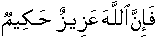
Recall the earlier times when Muna'fi'qoon: the imposter believers and they—psychological disorder is self implanted- nurtured within their hearts- locus of understanding - consciousness— were talking: "Their System-Prescribed code of conduct has deluded these people, the believers."
[they are themselves deluded people] Remain aware, if someone places reliance and dependence upon Allah the Exalted [victory/dominance is for him]—
Since Allah the Exalted is undoubtedly the All Pervasive, Dominant, the Infinitely Just Supreme Administrator of the created realms. [8:49]
:
The first two words constitute a verbal sentence in
order: Verb-Fronted object-delayed Subject. All English translations are
erroneous who render the object of verb as "disease" while the object is
third person, masculine, plural noun referring back to people under
discussion. Majority have erroneously translated the sentence
"Allah
has increased their disease".
The Root of verb is:
ز ى د which signifies to grow,
increase, augment, enhance, develop, overwhelm. This needed to be
disambiguated as to regarding what they were let increase, overwhelm.
The disambiguation accusative (in Arabic grammar تميز):
 removes the ambiguity, "Thereby,
it being their willful act, Allah the Exalted has
let them
overwhelm,
with regard to their
respective disease
[by leaving them as condemned- discarded]."
removes the ambiguity, "Thereby,
it being their willful act, Allah the Exalted has
let them
overwhelm,
with regard to their
respective disease
[by leaving them as condemned- discarded]."
Beware; a severe punishment is in wait- prepared for them; This upshot is because they kept publicly lying by deceptive proclamations of belief.
This is a inverted nominal sentence
like the one in 2:7. The reason for requital of
severe punishment is their habit of lying in their worldly life. When
deficient perfect verb:
 is followed by imperfect verb in indicative mood
the meanings of Imperfect verb are converted into past continuous verb;
it thus signifies an habit. It is their regular behaviour pattern
repeated so often that it has become typical of them:
is followed by imperfect verb in indicative mood
the meanings of Imperfect verb are converted into past continuous verb;
it thus signifies an habit. It is their regular behaviour pattern
repeated so often that it has become typical of them:

And Allah the Exalted bears witness that Muna'fi'qeen are certainly habitual liars. [63:01]
Know further about them; when it was said to them:
"You people should not purposely cause disorder - imbalance - distortions- spread wicked and unsound conjectural ideas in the society"—
They replied, claiming: "We are only the perfectionists". [2:11]
Beware; the fact is that they are truly the distorters- creators of disorder-imbalances- spreaders of wicked unsound ideas.
However, they perceive it not so. [2:12]
:
Particle "Waw" is the most frequently used cohesive tie. It is discourse
coordinator, sentence starter: Sentences within an expository text, after
the introductory sentence are often initiated with "wa"; the presence of "and"
signals the speaker's identification of an upcoming unit which is coordinate in
structure to prior unit.  :
has occurred for the first time. It is
Time Adverb.
It is a particle that can have a conditional
as well as temporal function.
In that case, the content of the condition refers to the
future. In this case the particle is often followed by a verb in the past tense
with a future perfect meaning. Since a particle with a conditional
meaning is involved the condition always will have to be completed by a result
clause which is the case for all conditional particles. As for this particle is
concerned, it is necessary that the conditional element in the sentence refers
to a known case which will happen in any case. Consequently there may be no
doubt about the conditions taking place. This way is stressed the temporal
character of the condition.
:
has occurred for the first time. It is
Time Adverb.
It is a particle that can have a conditional
as well as temporal function.
In that case, the content of the condition refers to the
future. In this case the particle is often followed by a verb in the past tense
with a future perfect meaning. Since a particle with a conditional
meaning is involved the condition always will have to be completed by a result
clause which is the case for all conditional particles. As for this particle is
concerned, it is necessary that the conditional element in the sentence refers
to a known case which will happen in any case. Consequently there may be no
doubt about the conditions taking place. This way is stressed the temporal
character of the condition.The sentence following it is grammatically considered in genitive state by construct (جملة في محل جر بالإضافة) like a possessive phrase.
 Verb: Perfect; Third person; singular;
masculine; Passive; [Form-I]; مصدر قولٌ Verbal Noun.
In a passive construction the focus is on the event rather than the agent. In
active voice verb we have subject and if transitive the object also. In Passive
voice the affected if mentioned is called Proxy Subject (نائب فاعل)
and is always in nominative case/state. Here the agent who said the quoted
statement is not specified, but the context clarifies that it was someone of the
true believers.
Verb: Perfect; Third person; singular;
masculine; Passive; [Form-I]; مصدر قولٌ Verbal Noun.
In a passive construction the focus is on the event rather than the agent. In
active voice verb we have subject and if transitive the object also. In Passive
voice the affected if mentioned is called Proxy Subject (نائب فاعل)
and is always in nominative case/state. Here the agent who said the quoted
statement is not specified, but the context clarifies that it was someone of the
true believers.  :
Prepositional phrase relating to verb. In English, about saying something to
others we use "to"- a preposition or adverb indicating the direction,
destination or position of something. But in Arabic for saying something to
someone, the preposition "ل
" is used which signifies "for". However, when we
use "for" to translate preposition "ل
" "When it was said for them" it can also mean as
if something was conveyed through third party to them and not face to face
conversation. Fact remains that in real terms whatever we say whether face to
face or convey it we say for the addressee since it is he who has to listen it
comprehensively or regard it just as noise by remaining inattentive or feels
dissonance.:
This verbal sentence is the direct object of the verb, that which was said.
:
Prepositional phrase relating to verb. In English, about saying something to
others we use "to"- a preposition or adverb indicating the direction,
destination or position of something. But in Arabic for saying something to
someone, the preposition "ل
" is used which signifies "for". However, when we
use "for" to translate preposition "ل
" "When it was said for them" it can also mean as
if something was conveyed through third party to them and not face to face
conversation. Fact remains that in real terms whatever we say whether face to
face or convey it we say for the addressee since it is he who has to listen it
comprehensively or regard it just as noise by remaining inattentive or feels
dissonance.:
This verbal sentence is the direct object of the verb, that which was said.
 :
نَاهية جَازمة Prohibitive Particle. When
it comes before second person conjugations of imperfect verbs it denotes
a negative/prohibitive/forbidding counseling. Its identification and
distinction from other uses/functions is evident by its having acted
as a Jussive Particle by rendering the following verb in Jussive
Mood. Compare use of
earlier in 1:07; 2:02; and before imperfect verb
in 2:06. It will help register in our memory its identification and
meanings facilitating quick understanding of its 1728 occurrences.
:
نَاهية جَازمة Prohibitive Particle. When
it comes before second person conjugations of imperfect verbs it denotes
a negative/prohibitive/forbidding counseling. Its identification and
distinction from other uses/functions is evident by its having acted
as a Jussive Particle by rendering the following verb in Jussive
Mood. Compare use of
earlier in 1:07; 2:02; and before imperfect verb
in 2:06. It will help register in our memory its identification and
meanings facilitating quick understanding of its 1728 occurrences.
 Verb: Imperfect; second person; plural; masculine;
Mood Jussive; [Form-IV]; [و] Subject pronoun, in nominative state;مصدر اِفْسَادٌ Verbal Noun.
The jussive [in Arabic: مجزوم] is a grammatical
mood of verbs for exhorting, counseling when preceded by prohibitive particle.
Its visual sign in third plural masculine verbs is that the last "Noon" is
dropped which is the sign of indicative mood.
Verb: Imperfect; second person; plural; masculine;
Mood Jussive; [Form-IV]; [و] Subject pronoun, in nominative state;مصدر اِفْسَادٌ Verbal Noun.
The jussive [in Arabic: مجزوم] is a grammatical
mood of verbs for exhorting, counseling when preceded by prohibitive particle.
Its visual sign in third plural masculine verbs is that the last "Noon" is
dropped which is the sign of indicative mood.The perception of the Root is also opposite to that of Root: "ح س ن" that signifies that each part of a thing is in exact proportion and contiguity to others and surroundings resulting in a beautiful pleasant look. Hence oddity and haphazardly dispersed state is the signification of Root: "ف س د".
There response was:
Beware; the fact is that they are truly the distorters- creators of disorder-imbalances- spreaders of wicked unsound ideas—
While they intend not to recognize it. [2:12]
Experts suggest that one of the criteria a book has to meet to earn title of a great book is that "The book has to speak from an important original setting. But a great book is one that is not trapped in its original setting. It has to be written in a way that constitutes it a living experience for readers today."
The form of text is expository and choice of words is such that it covers those Muna'fi'qeen who lived in the time-frame of revelation of Grand Qur'aan and those who thenceforth lived and are living in time and spare.
Moreover, when it was said to them, Muna'fi'qeen: Imposter believers,
"You people incline to accept likewise as other people have heartily accepted";
They replied: "Should we accept likewise as the Fools have accepted?"
No, the fact is that they
themselves are truly
the Fools []—
Since they aspire not gaining knowledge [under duality of thought to retain association with Non-believing Jews]. [2:13]
:
In this sentence
there are three affecting entities—the
participants are two different people, firstly someone of true believers who asked,
the others are
Muna'fi'qeen
who were asked; and the third
are those the second were directed to emulate. The third persons referred were
obviously known both to the speaker and his addresses. The addressee
Muna'fi'qeen
responded and
declared the third type of people as "the fools". Allah the Exalted rebuked
their statement and emphatically declared that in fact they themselves are truly
the fools but intend not to know it. in
2:142 will identify to us these remarkable people belonging to
Nisa'ra and
Jews of those days whose belief was declared worth emulation.
They abandoned their long held concept of East and West as Qibla-ta-Focal
Point and
returned to:


 the Community of Iebra'heim
alai'his'slaam, their ancestor,
by accepting Kaa'ba as the First and universal Qibla-ta.
the Community of Iebra'heim
alai'his'slaam, their ancestor,
by accepting Kaa'ba as the First and universal Qibla-ta.

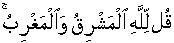


Henceforth, the Fools: Muna'afiqeen-averted from Procedural Code of Community of Iebra'heim [alai'his'slaam] amongst the People will keep enquiring-conversing amongst themselves;
"What is that which has caused them turn away from their Qib'la'tae; Focal Point, the one [East or West] upon which they henceforth adhered?"
You the Messenger Muhammad [Sal'lallaa'hoalaih'wa'salam] pronounce to new comers in Islam from the people of Book: "The East and the West are the domain exclusively for Allah the Exalted.
He the Exalted keeps guiding him; about whom He the Exalted so decides, towards the High Road: Course that keeps heading safely and straight to the destination of peace and tranquility". [2:142]
These directions, East and West are Qib'laa'tae of Nisara and Jews; in Madina Munawwara East and West has nothing to do with Kaa'aba and Aaq'saa/Bait Muq'aduss because they are respectively in North and South of Mad'ina.
in 2:13-frame of reference,
at the time of revelation the first were from amongst Jews-see 2:14
below.
Be informed: when they confronted those who had truly believed [whom they regarded fools on their back]; they said to them: "We have accepted- believed".
However, while they went in privacy with their people/bosses of devilish psyche and conduct, they said to them clarifying:
"Certainly, We are affiliated with you people. We only contrive jesting with them, the believers." [2:14]
Allah the Exalted by will and design keeps ignoring- discarding them.
Moreover, He the Exalted lets them prolonging in their defiant brims, leaving them in state of blind distracted wandering (in company of their brothers, evil-doers Refer 7:202) [2:15]
is
repeated in Ayah 2:76. This shows one face of Muna'afiqeen,
when they meet/confront the true believers. And their second face
is depicted in this information:
.
The prepositional phrase relating to the preceding verb:

 signifies that they went towards "their satanic
minded bosses" as is further evident by their statement they made before them:
"Certainly, We are affiliated with you people. We
only contrive jesting with them, the believers." The further
information associated with the first sentence in Ayah 2:76 gives new
information about the response to their explanation/excuse of associating
with the Believers:
signifies that they went towards "their satanic
minded bosses" as is further evident by their statement they made before them:
"Certainly, We are affiliated with you people. We
only contrive jesting with them, the believers." The further
information associated with the first sentence in Ayah 2:76 gives new
information about the response to their explanation/excuse of associating
with the Believers:
.gif)




Know it that on confronting those who had heartily believed, whom they declared fools on their back, said to them, "We have accepted-believed".
But when some of them went to others-the elders of Jews in privacy; they questioned them;
They the clergymen of Jews questioned them; "Do you disclose to-acquaint them: the believers about that which Allah the Exalted has disclosed-revealed upon you people?
Thus affording them an opportunity that they might challengingly argue with you about that which is from your Sustainer Lord?
Is it for reason that you people do not ponder-reflect?" [2:76]
We further find the information that the clergy leadership they met in privacy taught them deceptive tactics to try revert their men to their fold who had joined the true believers:



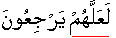
And scholarly-religious group of the people of Book directed their influenced people:
"Pronounce accepting that which is revealed to the Believers before them in the beginning of the day and at day-end denounce the belief therein.
By this method, there is possibility that those of our people who have become believers might return to us....... [3:72]
The objective of aforementioned deceptive tactic was: :
The pronouns refer to the target people of deceptive tactic. They were
desperate to win back those of their folk whom they called "the fools"
(2:13) while the believers were asking
Muna'afiqeen
to emulate them in belief. The
targeted true believers were of same origin as were
Muna'afiqeen,
members of Jew community:

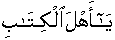



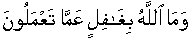
You the Messenger [Sal'lallaa'hoalaih'wa'salam] ask:
"O you the people of the Book!
Why you people repulse him—he who has believed, off the High road prescribed by Allah the Exalted by portraying it as obscure-crooked—
While you people act as testifiers.
Remain mindful, Allah the Exalted is never unmindful about that which you people are doing." [3:99]
[These fools do not understand that] Allah the Exalted by will and design keeps ignoring- discarding them.
Moreover, He the Exalted lets them prolonging in their defiant brims, leaving them in state of blind distracted wandering (in company of their brothers, evil-doers Refer 7:202) [2:15]
Narcissists are not stupid. They spin words and audience will be hanging on their every word. The Muna'afiqeen of those days upon visiting in privacy the elite of their parent community, the Jews tried to convince them of their continued affiliation and loyalty by stating:
"Certainly, We are affiliated with you people. We
only contrive jesting with them, the believers." How clever they are can be seen
in the choice of word:
 a Form-X Active
Participle, مصدر
اِسْتِهْزَاءٌ
Verbal noun. Its Root is:
ھ ز ء.
Basic perception is that of joking, talk in a playful manner, to make fun of
something or someone. In its irreducible semantic features emotion of hate,
scorn-to feel or display contempt or disdain for somebody, to despise are not
included. Had they used a word reflecting despise for the believers, their
stance would have become doubtful because one does not like to associate with
disdainful people.
a Form-X Active
Participle, مصدر
اِسْتِهْزَاءٌ
Verbal noun. Its Root is:
ھ ز ء.
Basic perception is that of joking, talk in a playful manner, to make fun of
something or someone. In its irreducible semantic features emotion of hate,
scorn-to feel or display contempt or disdain for somebody, to despise are not
included. Had they used a word reflecting despise for the believers, their
stance would have become doubtful because one does not like to associate with
disdainful people.
:
Allah the Exalted responding to their statement has used the verb from which is
derived the active participle they employed. There is a rhetorical device termed
"Antanaclasis" in which a similar word is repeated with different meanings or
sense.
Muna'afiqeen
had stated that they were taking the believers non-seriously and associating
with them just playfully. The extreme of taking someone non-seriously is to
discard and condemn him. Muna'afiqeen
who are declared as fools understand not that Allah the Exalted is by will and
design ignoring them as discarded. They understand not the severity of
condemnation but ask their selves about their unpleasant assertions:

And they say in their hearts,
"Why is it that Allah does not punish us for that what we say?"
[refer 58:08]
:
And
He the Exalted lets them prolonging
in their defiant brims, leaving them in state of
blind distracted wandering.
This information further confirms
the sense in which the preceding verb is used to convey persistent condemnation,
and not joking, mock as we see in almost all the available translations. Grand
Qur'aan is self explanatory and facilitates cross-checking the accuracy of
rendition of any sentence in target language text by rhetorical and cohesive
device of repeating phrases and sentences:



Should Allah the Exalted let someone absorbed in indifference-engrossed in his self, thereat; there is not at all a guide for him.
Know it; He the Exalted leaves such people in their state of flagrant defiant deviancy-brims; they have habit of blind distracted wandering. [7:186]


And if Allah the Exalted hastens damaging state for the people as they haste for the pleasantness, certainly their term would have been concluded for them.
Therefore, for reason of appointed term We let those prolonging in their defiant brims, leaving them in state of blind distracted wandering, who believe not in their presentation before Our Majesty for accountability. [10:11]

 :
This sentence is common in all the three Ayahs quoted above and in all three is
circumstantial clause. They people are in such state by will and design,
thereby, Allah the Exalted leaves-discards them to remain so.
:
This sentence is common in all the three Ayahs quoted above and in all three is
circumstantial clause. They people are in such state by will and design,
thereby, Allah the Exalted leaves-discards them to remain so.
The aforementioned are the people who have purposely purchased the vagrancy - straying exchanging with the Guidance - Grand Qur'aan.
Thereby, their "Instant Commerce" did not yield benefit [hope of enjoying favour of both parties; instead even lost confidence of their original party].
It retained them in a state of those who incline not to become guided aright. [2:16]
A coherent
paragraph has always a conclusion - a brief reflection or statement about the
main idea. After giving concise and succinct information about the people
introduced in the topic sentence, the verdict is given about them. This verdict
shows that the "disease" in their hearts is not a natural health
problem - their narcissism is a well thought volitional act with a
predetermined objective as reflected by the choice of perfect
Form-VIII verb:
 meaning
they have purposely purchased.
meaning
they have purposely purchased.
Word repetition is a common feature in all languages,
and serves different purposes, rhetorical, emphatic, or otherwise.
But its use in the Grand Qur'aan is at its peak of excellence. It
ties up the whole discourse compactly. The object of the verb is:
 the definite noun which is source of active participle:
the second category of people who do not follow:
as
stated in 1:6-7.They are specifically identified by characteristic
features of:
Muna'fi'qeen:
Imposter believers—the
Narcissist in the society of believers of exalted last Messenger
Muhammad
Sal'lallaa'hoalaih'wa'salam.
Thus the whole text up to this point is unified. For the non
believers, the reiteration of a word as object noun:
the definite noun which is source of active participle:
the second category of people who do not follow:
as
stated in 1:6-7.They are specifically identified by characteristic
features of:
Muna'fi'qeen:
Imposter believers—the
Narcissist in the society of believers of exalted last Messenger
Muhammad
Sal'lallaa'hoalaih'wa'salam.
Thus the whole text up to this point is unified. For the non
believers, the reiteration of a word as object noun:
 of
preposition
بـِ
has unified the text with the initial sentence with:
of
preposition
بـِ
has unified the text with the initial sentence with:
 in
Ayah 2:2.
in
Ayah 2:2.
:
This sentence begins with a conjunction particle "فَ
Fa", firstly it occurred
in 2:10. It conjuncts clauses, semantically signifies cause and effect
relationship and shows that later is immediately subsequent to the
former in time. The preceding clause showing their act was for reason of
their double-faced attitude
for enjoying sympathy and favour
of both
parties; but instead even lost confidence of their original party.




They the Muna'fi'qeen: Imposter believers are wavering-hanging in between; neither they are sincerely on this side nor are they on the other side.
Take note; Should Allah the Exalted discard and expose someone as neglectfully straying: Thereat, you you will never find for him a way out. [4:143]
For this reason their "Instant Commerce" did not yield benefit to them and this attitude retained them in a state of those who incline not to become guided aright.
The semblance - illustration of them/Muna'fi'qeen is like the illustration of a person who sincerely kindled a fire;
Thereat when the purpose was achieved—it the kindled fire had illuminated all that present around him—
Allah the Exalted took-faded away the white-light that reached them—
And He the Exalted discarded them/Muna'fi'qeen as self engulfed in layers of darkness; they are in mindset of observing and perceiving not. [2:17]
These Muna'fi'qeen: imposter believers act like a deaf, dumb, blind.
Resultantly, they revert not to guidance. [2:18]
:
It is a nominal sentence.
 :
Possessive Phrase: Noun: Definite; singular; masculine; nominative + Possessive
Pronoun: Third person; masculine; plural; genitive state referent to people
described earlier linking back to topic sentence-2:8;
:
Possessive Phrase: Noun: Definite; singular; masculine; nominative + Possessive
Pronoun: Third person; masculine; plural; genitive state referent to people
described earlier linking back to topic sentence-2:8;
 definite by construct is the Subject of the nominal sentence. It is from Root: م ث ل.
Its basic perception stated by
Ibn Faris [died
1005] is:
يدلُّ على مناظرَة الشّيءِ للشيء
that it leads to the perception of
visual
comparability and correspondence of a thing with another thing.
definite by construct is the Subject of the nominal sentence. It is from Root: م ث ل.
Its basic perception stated by
Ibn Faris [died
1005] is:
يدلُّ على مناظرَة الشّيءِ للشيء
that it leads to the perception of
visual
comparability and correspondence of a thing with another thing.
It is employed as figure of speech. In English it is described by the term: Simile. A Comparison or Simile, is, when the resemblance between two objects is expressed in form, and generally pursued more fully than the nature of a metaphor admits. The advantage of this figure arises from the illustration which the simile employed gives to the principal object. It help explain something or make it easier to understand. Therefore, comparisons ought to be founded on likenesses which are too obvious. Faint and remote resemblances will strain the mind of the reader to comprehend them, and throw no light upon the subject.
This Root is distinct from another Root: ش ب ه and word: تَشْبِيهٌ that shares its aspect of comparison but in a different way and between between a thing and phenomenon or hidden aspect of another thing, or abstract idea. Its equivalent term in English is Metaphor.
The fact about existing realities is that not all are visible to human naked eye. The Primal Creator and also the knowledgeable-observant-scientists convey the knowledge about realities not apparent to human eye by using the metaphors. Descriptions by metaphors enable people perceive a general idea-image of invisible fact by relating it to characteristic features of the metaphor.

 : Two successive Possessive Phrases, it is the predicate.

 : This verbal sentence-Verb-Subject-Object is the Linkage
Clause and the hidden Subject pronoun is referent to the preceding
Relative Pronoun. Verb is of Form-X.
This form equals form VIII plus a
causative affix.
Semantically it
adds connotation of seeking or aspiring for the meanings of its Form-I;
sought to be done by the Object. It shows the doer of action has a
sincere purpose. Its verbal noun pattern is:
استفعال
. George Sale and John Rodwell, the pioneer Christian translators,
overlooked the radicals: اِسْتَ
prefixed to the verb and converted it to its first Form for rendition in
English. Such practice results not merely in loss of the original text
but can distort the perception and even coherence element. All translators
who followed them have rendered erroneous translation; I have yet to
find one who did not copy them.
: This verbal sentence-Verb-Subject-Object is the Linkage
Clause and the hidden Subject pronoun is referent to the preceding
Relative Pronoun. Verb is of Form-X.
This form equals form VIII plus a
causative affix.
Semantically it
adds connotation of seeking or aspiring for the meanings of its Form-I;
sought to be done by the Object. It shows the doer of action has a
sincere purpose. Its verbal noun pattern is:
استفعال
. George Sale and John Rodwell, the pioneer Christian translators,
overlooked the radicals: اِسْتَ
prefixed to the verb and converted it to its first Form for rendition in
English. Such practice results not merely in loss of the original text
but can distort the perception and even coherence element. All translators
who followed them have rendered erroneous translation; I have yet to
find one who did not copy them.


 : This sentence begins with conjunction particle
"فَ
Fa", that signifies
cause and effect, and achievement of the purpose intended in the
preceding clause.
: This sentence begins with conjunction particle
"فَ
Fa", that signifies
cause and effect, and achievement of the purpose intended in the
preceding clause.
 It is a subordinating conditional adverb that introduces a subordinate temporal
clause which signifies the relationship between background and
foreground information.
:
It is a verbal sentence, feminine verb-hidden feminine subject pronoun,
and, object. The hidden feminine subject pronoun is referent to
preceding object noun of previous verb. This is the first feminine verb
we have encountered. Its last radical:
تْ
with pause sign is feminine marker not subject pronoun. The object is
Relative pronoun and:
is about its elided linkage
clause.
It is a
Possessive Phrase, first noun is Adverb of place signifying surroundings;
and the Possessive Pronoun: Third person; singular;
masculine; genitive state; is referent to the person who kindled
fire.
It is a subordinating conditional adverb that introduces a subordinate temporal
clause which signifies the relationship between background and
foreground information.
:
It is a verbal sentence, feminine verb-hidden feminine subject pronoun,
and, object. The hidden feminine subject pronoun is referent to
preceding object noun of previous verb. This is the first feminine verb
we have encountered. Its last radical:
تْ
with pause sign is feminine marker not subject pronoun. The object is
Relative pronoun and:
is about its elided linkage
clause.
It is a
Possessive Phrase, first noun is Adverb of place signifying surroundings;
and the Possessive Pronoun: Third person; singular;
masculine; genitive state; is referent to the person who kindled
fire.
:
It is the apodosis clause for the preceding conditional adverb and is a verbal
sentence. The verb is rendered transitive by using the preposition:
بـِ in prepositional phrase coupled with
possessive phrase:
 .
The object noun of preposition signifies the Visible Light and its
construct third person plural masculine pronoun is referent to the people under
discussion. Thus what was faded or taken away by Allah the Exalted is the
Visible/White Light that reached them; it is further evident from the
next clause:
.
The object noun of preposition signifies the Visible Light and its
construct third person plural masculine pronoun is referent to the people under
discussion. Thus what was faded or taken away by Allah the Exalted is the
Visible/White Light that reached them; it is further evident from the
next clause:

 :
And He the
Exalted discarded them/Muna'fi'qeen
as self engulfed in layers of darkness.
The prepositional phrase relates to the elided second
direct object of preceding verb, the first is the suffixed pronoun referent for
the people under description. The verb is doubly transitive that takes an
indirect object and a direct object. In view of preposition and substantive
plural noun denoted "within layers of darkness - located at a point
surrounded by darkness all around", the elided object is estimated as
"as self engulfed in the layers of darkness".
:
And He the
Exalted discarded them/Muna'fi'qeen
as self engulfed in layers of darkness.
The prepositional phrase relates to the elided second
direct object of preceding verb, the first is the suffixed pronoun referent for
the people under description. The verb is doubly transitive that takes an
indirect object and a direct object. In view of preposition and substantive
plural noun denoted "within layers of darkness - located at a point
surrounded by darkness all around", the elided object is estimated as
"as self engulfed in the layers of darkness".

 : This is circumstantial clause referent to the first object
pronoun of preceding verb; this is the circumstance they are in;
they are in mindset of observing and perceiving not.
: This is circumstantial clause referent to the first object
pronoun of preceding verb; this is the circumstance they are in;
they are in mindset of observing and perceiving not.
:
These are three predicates of the elided subject of the sentence - third person
masculine plural noun for the economy since it is understood from the preceding
sentences.
Or alternatively, semblance - illustration of them/Muna'fi'qeen is like the illustration of: صَيِّبٍ [Hyperbolic-Intensive participle] Supercell thunderstorm that has suddenly overtaken-descended from the Sky.
Layers of darkness and activity of excited movements, and luminosity-lightening keep happening within it: [صَيِّبٍ] Supercell thunderstorm.
They insert their fingers in their Ears on hearing stunning thunder-clap to guard fear of the death.
Know it; Allah the Exalted is all-encompassing those who are deniers - non-believing. [2:19]
 Appositive/Coordinating Conjunction Particle: [التخيير
alternative options:]
Appositive/Coordinating Conjunction Particle: [التخيير
alternative options:]
 It
is a Possessive
Phrase: كَ
Prefixed Exemplifying Noun. The Possessive Noun is Hyperbolic/Intensive participle.
It is
singular, masculine,
denoting a single entity.
Hyperbolic/Intensive participle signifies the one that enacts the base meaning
of its Verbal Noun exaggeratedly/excessively/intensively. Its
Root
"
ص و ب" denotes the overtaking-descending of a
thing that holds firmly and durably the ground-overtaken thing. Thus, it
describes Supercell thunderstorm that can persist for many hours.
It
is a Possessive
Phrase: كَ
Prefixed Exemplifying Noun. The Possessive Noun is Hyperbolic/Intensive participle.
It is
singular, masculine,
denoting a single entity.
Hyperbolic/Intensive participle signifies the one that enacts the base meaning
of its Verbal Noun exaggeratedly/excessively/intensively. Its
Root
"
ص و ب" denotes the overtaking-descending of a
thing that holds firmly and durably the ground-overtaken thing. Thus, it
describes Supercell thunderstorm that can persist for many hours.

 : This prepositional phrase relates to the elided
adjective for the preceding indefinite noun.
The
inner self of this
Hyperbolic/ Intensive active participle-
صَيِّبٍ
is portrayed by an
inverted nominal sentence:
: This prepositional phrase relates to the elided
adjective for the preceding indefinite noun.
The
inner self of this
Hyperbolic/ Intensive active participle-
صَيِّبٍ
is portrayed by an
inverted nominal sentence:


Supercell thunderstorm-In-Cloud Lightening

Would you believe if I say that the early 7th century Arabs of desert Hijaz were aware of activities and phenomenon taking place within a single thunderhead like the sort of excited and charged movements all over, and about in-cloud luminosity? You will certainly ask for the evidence. Honestly speaking, I do not have any authority or evidence in its support. But, the most famous book of the world reaching to me from them, i.e. Grand Qur'aan did say this to desert Arabs. Therefore, you have either to accept my unsubstantiated statement or you will have to believe that this Book was not authored by an Arab living in 7th century AD in the city of Mecca, but is a Divine Revelation.
It is the Prepositional Phrase, and the singular masculine
pronoun
refers back to صَيِّبٍ
Hyperbolic/Intensive participle. This phrase relates to the elided
fronted Predicate of the nominal sentence, and the preposition indicates
that the aforesaid three things are the inner self of the
Intensive Active Participle-state and the activities going on within it
since the verbal nouns signify only activity and state.
It is the delayed Subject of the Nominal Sentence, and is Plural feminine. It denotes layers of
darkness. The
following two Verbal Nouns are in opposition to it. Had these not been Verbal Nouns,
for apposition plural nouns were
needed in nominative case.
It is a verbal noun signifying an activity wherein is
excitement, and the whole thing is in excited and charged state.
This is the perception infolded in the Root as was portrayed by learned
Ibne Faris [died-1005] in these words:
يدلُّ على حركةٍ واضطرابٍ. وكلُّ شيءٍ اضطربَ
That it leads to the perception of movement, and agitating excitement and the whole thing is in commotion-charged stat
:
It
is also a verbal noun signifying firstly
the luminosity and gleam of a thing;
and secondly, congregation/joining of "blacks" and "whites" in a thing.
Learned Ibne Faris [died 1005] words:
لمعانُ الشيء؛ والآخر اجتماع السَّوادِ والبياضِ في الشيءi
It may be noted that the Verbal Noun:
is prior to and to it links as apposition the Verbal Noun:
.
Both are
within the صَيِّبٍ
Hyperbolic/Intensive participle.
Therefore, for this reason and grammatical structuring being in
apposition to a plural noun, these
two verbal nouns
cannot and
should not be taken as Object Nouns with the meanings as "thunder" and "lightening".
They signify only the verbal meanings as mentioned above. Within the
severe/super thunderstorm, the sequence is first:
and then
.
The excited and charged state and luminous and gleaming activity is happening within this: صَيِّبٍ. Did Arabs of 7th century, or even today does the majority of people the world over know about "In-Cloud Lightening"? Majority, in time and space, only knows about Cloud-to-Ground Lightening followed by listening sound of thunder as one sharp crack.
The
Meteorologists can better adjudge
whether or not
is like this?

This simile is for the Mun'afi'qeen. One avoids the Truth-Message either by remaining deaf, dumb and blind or for reason of considering it as threat to his interests. Mun'afi'qeen consider and react to the Message as some people react when suddenly faced with a violent thunderhead.
:
They insert their fingers in their Ears on hearing stunning
thunder-clap to guard fear of the death.

 :
It is a possessive phrase and is Causative Adverb,
in Arabic:المفعول
لأجله, also termed
.المفعول له
The Causative Adverb suggests the reason/purpose for which an action came to be. Verbal nouns [مصدر],
mostly indefinite, and in Possessive phrase as is the case here, has the
capacity to act as Causative Adverb. It is typical trait of
Mun'afi'qeen:
:
It is a possessive phrase and is Causative Adverb,
in Arabic:المفعول
لأجله, also termed
.المفعول له
The Causative Adverb suggests the reason/purpose for which an action came to be. Verbal nouns [مصدر],
mostly indefinite, and in Possessive phrase as is the case here, has the
capacity to act as Causative Adverb. It is typical trait of
Mun'afi'qeen:

They apprehend/think that every sound blast will effect/fall upon them. [Refer 63:4]
They are the people who fear the sound of thunder, a phobia called Brontophobia, also known Astraphobia. In an effort to avoid listening the sound of the thunder, when in the open, they cover their ears.
:
Know it; Allah the Exalted is
all-encompassing those who
are deniers - non-believing. It is
nominal sentence.
The lightening might soon blur - obscure their vision faculty—Ophthalmic effect.
Whenever lightening caused illuminating flash for them, they walked therein; and when it caused darkening effect upon them they stopped stand still.
However, had Allah the Exalted so decided, He would have taken away their faculty of hearing and visions.
It is a fact that Allah the Exalted is eternally the Causality Determiner upon every and all things. [2:20]
 It is a
Deficient
Verb: Imperfect; third person; singular; masculine; Indicative Mood
evident by
ـُ vowel sign;
كَوْدٌ Verbal noun.
It is a
Deficient
Verb: Imperfect; third person; singular; masculine; Indicative Mood
evident by
ـُ vowel sign;
كَوْدٌ Verbal noun.
 :
It is the subject noun ( اسم يَكادُ)
of the preceding deficient verb.
:
It is the subject noun ( اسم يَكادُ)
of the preceding deficient verb.

 :
It is a verbal sentence and is termed the predicate of deficient verb in
accusative state. The hidden subject pronoun of verb is referent to the
preceding definite noun. The verb does not denote, as has commonly been rendered in
English translation, "snatching" because it is odd to pair it with the sight.
Lightening does not snatch sight; it causes
ophthalmic
effects, usually corneal injury, other eye injuries include retinal bleeding and
retinal detachment.
Corneal injury is a wound to the part of the eye known as the
cornea. The cornea is the crystal clear (transparent) tissue that covers the
front of the eye. It works with the lens of the eye to focus images on the
retina. It results in blurred vision.
:
It is a verbal sentence and is termed the predicate of deficient verb in
accusative state. The hidden subject pronoun of verb is referent to the
preceding definite noun. The verb does not denote, as has commonly been rendered in
English translation, "snatching" because it is odd to pair it with the sight.
Lightening does not snatch sight; it causes
ophthalmic
effects, usually corneal injury, other eye injuries include retinal bleeding and
retinal detachment.
Corneal injury is a wound to the part of the eye known as the
cornea. The cornea is the crystal clear (transparent) tissue that covers the
front of the eye. It works with the lens of the eye to focus images on the
retina. It results in blurred vision.
The Root of verb:
is:
خ ط ف,
used seven times. Its meanings were described by
Ibn Faris [died-1005]
as:
استلابٌ في خفّة—depriving
someone of something suddenly and quickly. Other Classical lexicons and Lane's
lexicon say that it is said of an arrow that falls upon ground and then glides along upon the
ground to the object of aim. Arrow pricks the object not snatches any
part of object, like the lightening that damages the sight. Quickness in pace or
going, element of suddenness is there in it. They further refer
to a certain bird of a desert and is said to be thus called
because of the swiftness with which it pounces down, a bird that sees its shadow
and thinks it to be prey upon which it advances.
The accuracy of aforesaid understanding is immediately confirmed
in the sentence::
However, had Allah
the Exalted so decided, He would
have taken away their
acoustic and
optical faculty—faculty of hearing and
observation.
Its effect on the victim will be becoming deaf and blind deaf.
:
The hidden subject of both the verbs in this sentence is referent to the
Lightening. The lightening has two immediate effects, illumination for the eyes
and then sudden feel of darkness.
:
It is a nominal sentence. The paragraph is closed by mentioning the dominance of
Allah the Exalted to persuade people to remember there is always the possibility
of aforementioned happening since He is the
Causality Determiner upon
every matter to set things in right proportion.
Contents:
1)
One of the characteristic features of Grand Qur'aan is:
 ,
,
 it categorizes and classifies matters on every subject.
Human being is
it categorizes and classifies matters on every subject.
Human being is
Be aware of such person affiliated with the set of people (in those days Jews) who proclaims;
"We have accepted the belief in Allah the Exalted and the Last Day";
But the position is that in truth and entailment they are certainly not the believers. [2:08]
They are Muna'fi'qeen, the first characteristic feature of Muna'fi'qeen is their claim of believing in Allah, the Last Day and verbally testifying that Muhammad Sal'lallaa'hoalaih'wa'salam is certainly the Messenger of Allah the Exalted as told in 63:01. Therefore, it should not be translated by the word Hypocrite, since amongst non believers there could be hypocrites but they are NOT Muna'fi'qeen, they will have a better class-place in Hell-Prison than Muna'fi'qeen-the Imposter believer.
Responding to their claim, Allah the Exalted, in the last declarative sentence, has declared that in truth their statement does not entail belief. He the Exalted does not consider them believers. They will be considered believers only if they accepted what is stated in 4:65.
The objective is later told plainly:
"These Muna'fi'qeen have consciously and purposely adopted their declarations as protective shield/ deception" [Refer 58:16 and 63:02]
They seek by contrary to fact verbal assertion to beguile Allah the Exalted and convince those who have accepted consciously and truly [the Messenger and Grand Qur'aan].
However, in fact they deceive none by false declaration of belief except their own selves.
Meanwhile they analyze not to realize-perceive this fact [since do not see beyond their selfish stakes]. [2:09]
Pathological beliefs-a disease-psychological disorder-envy, jealousy, and malice, bias, rancour is self implanted-nurtured within their hearts-locus of understanding-consciousness.
Thereby, it being their willful act, Allah the Exalted has let them increased-flourished with regard to their respective disease [by leaving them as condemned-discarded].
Beware; a severe punishment is in wait-prepared for them.
That is for reason that they kept publicly lying by deceptive proclamations of belief. [2:10]
Moreover, when it was said for them: "You people should not purposely cause disorder-imbalance-distortions-spread wicked and unsound conjectural ideas in the society";
they replied, claiming: "We are only the perfectionists". [2:11]
Beware; the fact of the matter is that they are truly the distorter-creators of disorder-imbalances-spreaders of wicked unsound ideas.
However, they realize it not. [2:12]
[since don't reflect/do not see beyond their selfish vested interests]
Moreover, when it was said to them-Muna'fi'qeen: "You people incline to accept likewise as other people have heartily accepted";
they replied: "Should we accept likewise as the Fools have accepted?"
No, the fact of the matter is that they
themselves are truly
the Fools []. However, they know
not-intend
to know it [under duality of
thought to retain association with Non-believing Jews]. [2:13]
[it refers to those persons who were definitely recognized both by speakers and listeners at that point in time]
Be informed: when they confronted those who had truly believed [whom they regarded fools on their back]; they said to them: "We have accepted-believed".
However, while in privacy with their colleagues of devilish psyche and conduct, they said to them clarifying: "Certainly, We are affiliated with you people. We only contrive jesting with them". [2:14]
[read in conjunction 2:76, it confirms that earliest Muna'fi'qeen were from amongst Jews]
[These fools do not understand that] Allah the Exalted by will and design keeps ignoring-discarding them with contempt.
Moreover, He the Exalted lets them prolonging in their defiant brims, leaving them in state of blind distracted wandering (in company of their brothers, evil-doers Refer 7:202) [2:15]
They are the people who have purchased the vagrancy-straying exchanging with the Guidance-Grand Qur'aan.
Thereby, their "Instant Commerce" did not yield benefit [hope of enjoying favour of both parties; instead even lost confidence of their original party].
It retained them in a state of those who incline not to become guided aright. [2:16]

Their-Muna'fi'qeen: imposter believers semblance: it resemblance a person who diligently kindled a fire;
Thereby, the moment the kindled fire energized and illuminated his surroundings; Allah the Exalted caused fading away visual faculty of them: Muna'fi'qeen.
And He the Exalted has discarded them in layers of darkness where they observe not. [2:17]
These Muna'fi'qeen: imposter believers act like deaf, dumb, blind.
Resultantly, they do not revert to guidance. [2:18]
[One responds only when reflects and differentiates, see 2:171]
Or alternatively, their example is as if a صَيِّبٍ Hyperbolic-Intensive participle-Supercell thunderstorm has suddenly overtaken them from the Sky.
Layers of darkness and activity of excited movements, and luminosity-lightening keep happening within [him-صَيِّبٍ] Supercell thunderstorm.
They press their fingers in their Ears on hearing stunning thunder-clap to guard fear of the death.
Know it; Allah the Exalted is ever over those who deliberately refuse to accept. [2:19]
One avoids the Truth-Message either by remaining deaf, dumb and blind or for reason of considering it as threat to his interests. Mun'afi'qeen consider and react to the Message as some people react when suddenly faced with a violent thunderhead.
The lightening may soon blur-obscure their vision faculty.
Whenever lightening caused illuminating flash for them, they walked therein; and when it caused darkening effect upon them they stopped stand still.
However, if it were the will of Allah the Exalted, He could have taken away their faculty of hearing and visions.
It is a fact that Allah the Exalted is eternally the Causality Determiner upon every and all things. [2:20]
They the Muna'fi'qeen: Imposter believers are wavering-hanging in between; neither they are sincerely on this side nor are they on the other side.
Take note; Should Allah the Exalted discard and expose someone as neglectfully straying: Thereat, you you will never find for him a way out. [4:143]
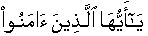



O those/you who proclaim to have accepted-become believers, listen;
You people should not incline adopting the Deniers of belief as companions-guardians protectors-godfathers-patrons instead of the Believers.
Do you people intend-wish that there might be a clear evidence-reason for Allah the Exalted for taking cognizance against you? [4:144]


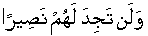
Know the fact; Muna'fi'qeen: the Imposter believers will certainly be placed in the lowest-worst class of the Hell-Prison.
And you will never find anyone inclined for helping them. [4:145]
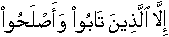


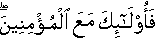


Exception shall be for: Those who returned repenting and consciously corrected-mended the direction of conduct-perfected themselves;
And restrained and restricted themselves with the Book of Allah the Exalted;
And they purified their Code of Conduct-Way of life sincerely and exclusively for Allah the Exalted:
Thereby, they are in the company of the true believers.
Be aware; Allah the Exalted will soon give the true believers reward, the great one. [4:146]

o
[Read with
33:26;59:02]

[Same information in same words in
33:38]
[Same pronouncement in 35:43]o
[therefore it was pronounced] A proclamation that if the Muna'fi'qeen, and those who have a disease in their hearts and they are the creators of disturbance and disquiet in the city Madina did not desist
We will certainly let you overpower them definitely, thereafter they will not remain your neighbors except for a little while, [33:60]
cursed and condemned; [they did not desist resultantly] wherever they were found they were seized and removed from society [either by exile or arrest] in the manner as condemned and discarded away. [33:61]
This has been the tradition/Way of Allah amongst those who have passed in earlier times;
and you will never find for the tradition/Way of Allah any change/replacement. [33:62 Replica/Mirror 48:23]
What is relationship of wood with them; how Nifaq develops--building blocks--cylindrical--parallel---