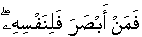
:
Visual imagery
:
Visual imageryGrand
Qur’ān is declared:
:
Visual imagery
The objective of a book is accomplished when its text creates an impression in the reader's mind. A powerful tool to achieve this objective is imagery, a figure of speech, which employs words to create mental images in the mind of the reader. It makes the reader feel as if he is present in the very moment, right between the lines. Words that do not stimulate imagination are just symbols sprinkled on a blank piece of paper. Images and emotions are recreated by using vivid descriptions and comparisons with the help of sound words.
Grand Qur’ān illustrates in a unique way by the choice of such words whereby it produces images and describes events as though were happening in front of the reader. Its vivid descriptions portray image in such manner as if it were being displayed in a live recording. The reader feels watching the past and future events visually. Let us listen the elevated Messenger of Allah the Exalted:
|
|
:
It is an epithet for Grand Qur’ān; grammatically singular, but morphologically broken plural of singular:
 which signifies:
"Mental perception; the perceptive faculty of the mind"
[Lane
Lexicon]. Its Root is "ب ص ر"; basic perception infolded in
it is that of such seeing as
yields knowledge-mental perception.
Man is equipped with three faculties for acquiring "Knowledge"
which he lacks at birth:
which signifies:
"Mental perception; the perceptive faculty of the mind"
[Lane
Lexicon]. Its Root is "ب ص ر"; basic perception infolded in
it is that of such seeing as
yields knowledge-mental perception.
Man is equipped with three faculties for acquiring "Knowledge"
which he lacks at birth:


Realize it; Allah the Exalted brought you people out of the bellies of your respective mothers in a state that you were not aware of matter: something possessing dimensions, material realities of the new world you entered in.
And He the Exalted has assigned for you people the faculty of processing sounds and verbal information; and the faculties of multiple visualizations; and faculty of Processing-Integrating-Perceiving: Baking establishments: the Brains/Minds. [Refer 16:78; 32:09; 67:23]
The ascending order of placement of words representing faculties-senses [not organs] might be of interest for scholars and researchers who are interested in examining questions like the encoding, store, retrieval information, development of discrimination abilities, perceptual and conceptual category formation, problem solving, recognition and recall memory, language comprehension, and reasoning about the physical and social worlds, etc.
The second faculty assigned for acquiring
knowledge is
 plural of
 .
This sensory faculty; unlike
.
This sensory faculty; unlike
 :
hearing or listening;
signifies the percipient desire
of a person because it does not refer to mere seeing-glancing. Seeing is more of a passive process.
Attention to a particular
detail or details within the visual scene for the
extraction of salient information and its further
evaluation is
:
the observation.
It signifies focused attention
to discriminate one thing from all others, whereby it gets recorded in the
memory with its distinct features, dimensions, traits,
description; or is assigned a tag-code-folder-file name in
relation and contrast to surroundings-related things.
Moreover,
it needs visible light that makes the object
:
hearing or listening;
signifies the percipient desire
of a person because it does not refer to mere seeing-glancing. Seeing is more of a passive process.
Attention to a particular
detail or details within the visual scene for the
extraction of salient information and its further
evaluation is
:
the observation.
It signifies focused attention
to discriminate one thing from all others, whereby it gets recorded in the
memory with its distinct features, dimensions, traits,
description; or is assigned a tag-code-folder-file name in
relation and contrast to surroundings-related things.
Moreover,
it needs visible light that makes the object
 :
observing, spectator, one that makes itself perceptible-observable to
: the
faculty of observation.
:
observing, spectator, one that makes itself perceptible-observable to
: the
faculty of observation.
|
|
|
|
Listening and vision constitute a "pair", and when integrated they yield information-knowledge. The percipient listening and observation activates the conscious brain to work. Attention is the signaling of person's intention and is in fact a command to the brain to accord priority for processing of given data into information; and to carefully secure it for quick and easy retrieval. The Logical brain is henceforth in full command of other two brains-Emotional and Survival, rendering all three at the service of the owner person-the "I" in the human body. The distraction is only in response to serious threat stimuli from the surroundings.
Listening and observation provide data. Percipient
listening is in fact the verbal image of observed object. Processing and
development of
data into information is a coordinated relationship between verbal imagery and actual objects,
each discerned and distinguished-discriminated from others along with
their mutual relations. This information needs to be stored in folders and files for easy access and retrieval.
All these functions are the domain of:
 :
the processors and integrators of data inputs:
baking establishments: bakers; brains.
:
the processors and integrators of data inputs:
baking establishments: bakers; brains.
;
 and
and
 are three faculties inserted
in human body for acquiring knowledge to rise from
the initial
are three faculties inserted
in human body for acquiring knowledge to rise from
the initial

 :
the age of unaware feebleness to
Strengthen-Knowledgeable Personality of Passion, Reason, will and distinct
exponent. Thereat, he gets the status and
appointment:
:
the age of unaware feebleness to
Strengthen-Knowledgeable Personality of Passion, Reason, will and distinct
exponent. Thereat, he gets the status and
appointment: :
self-governor enjoying freedom, discretion and
executive authority of will of self rule-decision.
:
self-governor enjoying freedom, discretion and
executive authority of will of self rule-decision.
|
|
:
It
is the delayed subject of preceding verb:
 with
suffixed fronted object pronoun second person, masculine, plural
referring individually and collectively the living humanity.
with
suffixed fronted object pronoun second person, masculine, plural
referring individually and collectively the living humanity.

 :
[متعلقان بمحذوف
صفة بصائر أو بالفعل]
This
Prepositional Phrase coupled with Possessive Phrase relates to
the elided adjectival description of the preceding Subject or could be
considered as relating to the verb; without making much difference in
the meanings. This sentence is the description of the contents of Grand
Qur’ān mentioned at the start of this discourse:
:
[متعلقان بمحذوف
صفة بصائر أو بالفعل]
This
Prepositional Phrase coupled with Possessive Phrase relates to
the elided adjectival description of the preceding Subject or could be
considered as relating to the verb; without making much difference in
the meanings. This sentence is the description of the contents of Grand
Qur’ān mentioned at the start of this discourse:
|
|
The sublimity of
text of Grand Qur’ān is evident in every sentence of it. The word
"book" and Qur’ān is masculine. It comprises of miscellany of:
 which is a plural
feminine
noun: the verbal passages of Grand Qur’ān. Likewise,
is also broken
feminine plural but grammatical
singular. This can be taken as an epithet; a figure of speech, which is
best defined as a descriptive title that commonly involves a word or a
phrase that is used in lieu of the other noun:
.
The perfect Verb
is masculine singular; grammatically its
subject can be feminine when distanced away from the verb; here it is
distanced away by the fronted object suffixed second person pronoun.
which is a plural
feminine
noun: the verbal passages of Grand Qur’ān. Likewise,
is also broken
feminine plural but grammatical
singular. This can be taken as an epithet; a figure of speech, which is
best defined as a descriptive title that commonly involves a word or a
phrase that is used in lieu of the other noun:
.
The perfect Verb
is masculine singular; grammatically its
subject can be feminine when distanced away from the verb; here it is
distanced away by the fronted object suffixed second person pronoun.
The
:
descriptive verbal passages of Grand Qur’ān are
:
luminous enlightenments; they stimulate
imagination; they open the eye of heart/mind-understanding. They are the
live imagery of physical realm; they warp time-space making it easy for
the reader to conveniently see and perceive. Therefore, the elevated
Messenger
Muhammad
Sal'lallaa'hoalaih'wa'salam
has point-blank cautioned us:
|
|
The fact that the verbal descriptive passages of Grand Qur’ān are evocative luminous enlightenments is again mentioned twice that highlights its significance; and emphasizes upon the reader for concentrated reading to perceive it as visuals which gives a lasting memory and ability for spontaneous retrieval.
|
|
|
|
Like the purpose of authoring a book, the objective of critical reading is accomplished when semantic information is filmed in the explicit memory; he has formed a mental picture particularly of that information that may occur or be possible in the future. This enables him to remain on guard since retrieval of pictured information from memory is most easy and spontaneous. It is elaborated:
|
|
It is our everyday experience that some visuals instantly effect us; pleasingly or disturbingly. Many people start weeping feeling melancholic on watching a scene-tragedy in a movie. Horror movies terrify. A critical and careful reading of marvelously worded passages of grand Qur’ān creates similar imagery and effect on the reader:
|
|
The verbal passages of Grand Qur’ān cause the knowledgeable and attentive listener take a reflexive surrender posture on having imaged the imminent danger in wait and awful end of many:
|
|


It is a fact that only such people heartily believe in Our Aa'ya'at: Unitary Verbal Passages of Qur’ān, who when reminded with these passages voluntarily dropped in front in the state of those who prostrate laying forehead on the Earth.
And in prostration they repetitively praised the Glory of their Sustainer Lord.
Take note, they are the people who never puff themselves with self presumed pride of grandeur. [32:15] [Please prostrate]

 :
The sincere allegiants of Ar'Reh'maan,
the Supremely Exalted Lord of all realms, listen the explicitly
explicative verbal passages of Grand Qur’ān very attentively; and read
them envisioning:
:
The sincere allegiants of Ar'Reh'maan,
the Supremely Exalted Lord of all realms, listen the explicitly
explicative verbal passages of Grand Qur’ān very attentively; and read
them envisioning:
|
|
The day we start reading the Grand Qur’ān following the norms about how to read a book using our own brains for imagination and grasping the imagery; the time-space will be squeezed in the eye of our heart. The exalted universal Messenger Muhammad Sal'lallaa'hoalaih'wa'salam has unfolded for us the invisible realities by the explicit will of his Sustainer Lord, Allah the Exalted Who confirms:
|
|
Grand Qur’ān is alive in time and space. Its sublime characteristic is that it warps the space-time. Its par excellence imagery can make us feel living in the remote past as well as in the remote future despite being beyond the catch of our visual faculty. We should read it extremely carefully to locate ourselves as to where are we placed ultimately: Hell-prison or the Paradise.