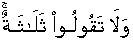
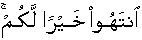
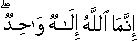
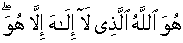
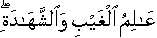
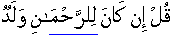
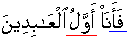
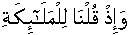
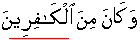
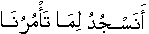
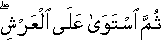
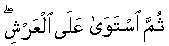
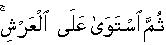
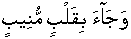
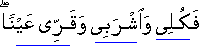
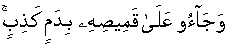
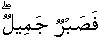
(ذُو
ٱلْجَلَٟلِ وَٱلْإِكْرَامِ)

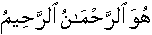
Ar'Reh'maan:
the Proper Name of Allah
the Exalted
:
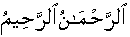
Ar'Reh'maan: This unique, rarest of the rare Personal Name of
Allah the Exalted has widely been discussed by scholars, Muslims, Jews
and Christians included, for determining its meanings by considering it
as an exclusive Attribute of the Sustainer Lord of the Universes.
George Sale had translated it as "the
most merciful" and John Medows Rodwell as "compassionate". The other
translators in timeline have merely copied them and likewise translated
it as an adjectival with synonyms or synonymous words like "most
gracious"; "the beneficent"; "the All-merciful". No translator and
exegete, to the best of my knowledge and study, considered it as Proper
Name.
Grand Qur’ān is perhaps
the only book about which scholars, both believing and non-believing,
quite often opt not to adhere to otherwise well accepted norms of
behaviour - academic discipline of transferring a book of one language
to another language. Just one example suffices to prove this unusual
practice. One of the basic obligations of a Translator, who has
self-assigned the task of translating a book into another language, is
that he should firstly thoroughly study it to locate the Proper Nouns and identify them whether
it is name of a person/sentient, place, or organization.
We have in academics means and methods to distinguish a
Proper Noun -
Personal Name in a lengthy text. None seems to have cared to resolve whether
Ar'Reh'maan is the Proper Noun - Name of
Allah the Exalted, despite the fact that it finds mention for fifty-seven times in the text of Grand Qur’ān;
fully declinable in all
cases, nominative, accusative and genitive.
With regard to nouns, the basic distinction in languages is common noun
and proper noun. The perception of the contents of source
text may be distorted extensively if it is not resolved about a noun as
to whether it is a common noun or proper noun, and whether it is
descriptive or non-descriptive.
Proper noun is the name of a particular, individual person, place,
community, or thing
who/which is usually unique; it has a singular reference. A common noun on the
other hand is a name in common to every person
or thing of the same class or kind.
According to the Encyclopaedia Britannica:
|
"a name is a word or group of words used to refer to an
individual entity
(real or
imaginary)"
(vol.24, p.733). |
The
name is the code that gives basic
cognition of
existence and presence of a thing and person. Hence,
name is the introduction for apparent/initial cognition of a thing and
person. Cognition of the
code/name of a thing or person is the
first
step in gaining knowledge about the thing or person. Name of a thing or
person gives it or him a vivid distinction from all other things and
persons and makes it or him distinguished, identified, definite and
isolated [معرفة];
and grants ability to others to identify, and describe/remember/recall
and/or mention-refer it or him to others. The name/code serves as a
basis/foundation for others to enquire and study about it to gain
further knowledge.
In Arabic the
equivalent of name, code, noun is:
 that stems from Root:
س م و. The basic perception infolded in it is of eminence,
elevation, ascension, transcendence, and loftiness of a thing spread and
overshadowing another thing.
that stems from Root:
س م و. The basic perception infolded in it is of eminence,
elevation, ascension, transcendence, and loftiness of a thing spread and
overshadowing another thing.
Attributive names/adjectival descriptions
- epithets give further information, insight and knowledge about the thing or
person introduced by a Personal Name-Proper Noun. These
are complimentary in nature and help acquaint others about the
inner-self [بَاطِن] of the named
entity - object or person/being. Every person
and thing/object has two aspects; the one evidently apparent [ظَاهر]
notwithstanding whether or not it is in the range of focus of someone,
and the other is the inner-self, hidden, infolded, not apparent but
invisibly embedded therein: بَاطِن.
The evidently apparent [ظَاهر]
is the reflection of the fact of existence, and its cognition and reference is
by the Name. The
pursuit-journey of knowledge is from cognition of existence/Name towards
knowing and perceiving the inner-self [بَاطِن] of that which exists and
its relationships and equations with all that exists. We cannot have the
absolute knowledge of anything and person/being unless we know its/his
inner-self [بَاطِن] after its cognition, introductory knowledge of its
Name.
Once we know the inner-self,
all that is secreted, hidden and its relationships with everything else,
we know and recognize that thing and Person in near absolute sense. Thereupon,
it or He becomes more visible and apparent than the shining Sun in a
bright day, even without being in visual sight—the
[ظَاهر]
aspect of Him. Therefore,
we know Him/him with such conviction, which is the absolute-exalted end
of the knowledge. This type of knowledge,
with reference to personalities, can be attained only about two,
Allah, Ar'Reh'maan the Exalted; and Muhammad Sal'lallaa'hoalaih'wa'salam—the
mercy Personified, since the: بَاطِن of
both is quite extensively visible to us all around, and that of the
Spokesperson - the elevated Messenger through the
courtesy of Grand Qur’ān.
Personal names are not translated in any
language of the world. Proper names must be transcribed in the alphabet
of other languages in the manner that a non-native produces the same - as-near-sound as is in the original language.
Who could be a better Translator than Allah the Exalted and setter of
norms and manners of translation? He the Exalted has translated
perspectives of many people of various lands and languages into Arabic
which are incorporated in the text of Qur’ān. He the Exalted never
translated the Personal Names by meanings but spelled them in Arabic to
produce near-equal sound of the name as was in foreign-to-Arabic language.
We know that the Exalted Personalities have cognition by
their Proper Name; and they are called or addressed by Title and/or
personal Name for seeking their attention.
Muhammad
Sal'lallaa'hoalaih'wa'salam is the guide
lord for humanity, he is advised to tell us:
-
At whatever point in time
should you wish to seek attention,
you should address with attribution
since the names attributing the sublime connotation of exacting
balance/ proportioned/ equilibrium/ virtue/ admirable/ grandeur/ just/majesty/absoluteness/beauty are appropriate and exclusive for
Him (Ar'Reh'maan)
the Exalted.
|
-
Moreover, you
individual should neither perform aloud your Salat: Time bound protocol of servitude and allegiance nor should you
reduce it to sub-vocal/zero audibility.
Instead, find a way out in between two extremes."
[17:110]
|
We formally call/address persons by the status, or position held by
him or informally calling by his personal name.
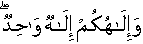
In between:
 and
and
 is:
is:
 which means "or,
alternate-interchangeable-appositively, either"; and thus it is reflected
that both are the exclusive distinct Names of the
same Being Who is The
Only Iela'aha: Sovereign Lord of the peoples.
which means "or,
alternate-interchangeable-appositively, either"; and thus it is reflected
that both are the exclusive distinct Names of the
same Being Who is The
Only Iela'aha: Sovereign Lord of the peoples.
Important to note and remember: The Personal Name:
is
unique; exclusive;
no dual, no plural, no feminine
equivalent.
Personal Name that introduce and grant cognition of an existing
personality,
unlike attributive-adjectival names-descriptions, never
have duality and plurality. Neither there is any process/phenomenon/rule
in the Arabic language for “feminization” or "masculinisation" of proper
nouns/names.
Moreover, first
two letters in the Proper Names:
 and
should never be considered and equated with Definite Article:
and
should never be considered and equated with Definite Article:
 since
it is the intrinsic and inherent part of the Names.
since
it is the intrinsic and inherent part of the Names.
This name is unprecedented, this has no
parallel:
 :
It is a Noun; quasi passive participle; and signifies assigning a name
to a person:
:
It is a Noun; quasi passive participle; and signifies assigning a name
to a person:
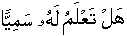
About the unique name: Ar'Reh'maan a question is asked to
answer in yes or no that none other has this name:
Without the code/name,
existence of a thing is not acceptable, it is non-existent. Equally, without existence of a thing/matter or
person in actual reality, any name/code assigned for such imaginative
thing/existence is of no significance and is merely meaningless
utterances of the mouth [In Arabic: أَفْوَاهِهِمْ].
In our attempt to resolve the issue we
will rely upon the
Grand Qur’ān to let us know whether it is the Personal Name of Allah
the Exalted, or could it be stretched and considered as an Adjectival Name
attributing a qualitative trait.
We will study its use by
reference to collocation context for its recognition-classification, as
to whether it is Proper Noun or an adjective. A habitual word-combination is called collocation.
We will study
under the following sub-headings:
-
Rules of Arabic language signify it only as Personal Name.
-
Allah -
Ar'Reh'maan
the Exalted is to be recognized as:
 .
.
-
Allah -
Ar'Reh'maan
the Exalted is to be recognized as the Sustainer Lord of peoples and of
all in the physical realm.
-
Creator of things is identified and
referred by Proper Name, be it an individual person or a company,
organization.
-
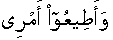
The Subject [عَبْد
plural عباد] is identified only by the
Proper Name of his Lord Allah - Ar'Reh'maan the Exalted.
-
Prostration-obeisance is before and
for the
Person, and not for his traits.
- One is mentioned
by Personal Name who adorns the Throne/Seat of
Sovereignty; and not by adjectives.
- A person makes a promise. Promise-maker finds mention
by title or personal name.
-
An agreement, contract, covenant, pact
is with reference to party's Title or Personal Name.
- Mention of Permission, Authorization, and Proclamation is
always by the Name of the authority.
-
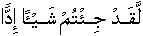
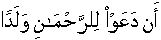
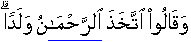
People relate a son [very as well adopted] with Personal Name of
the one with whom they relate a son.
-
The Unitary Verbal Passages and other signs are related to Allah and
Ar'Reh'maan,
the Exalted; not by adjectival noun - epithet.
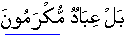
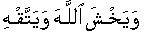
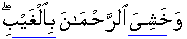
- Awe is
associated with Allah the Exalted as well with other proper name: Ar'Reh'maan.
Rules of Arabic language signify it only as Personal Name.
The nouns in Arabic, whether Proper Nouns or
Common Nouns, in their default
state are always "Nominative"; in Arabic مرفوع
: its visual recognition is the
presence of vowel sign ـُ
on the last consonant of the
noun.
A peculiar and
distinguishing feature of Arabic language is that; unlike other
languages, say English and Urdu in which the adjective comes
first-prioritized than the described one, the مُوْصُوف/the
one being described/portrayed is always mentioned first followed
by the
صِفَة/Adjective. Arabic, the language of our guide lord
Muhammad
Sal'lallaa'hoalaih'wa'salam,
is a language of truth and absolute fact.
The one
being described/portrayed; in Arabic:
منعوت
or
مُوْصُوف, is mentioned first since
it/he is First in
Existence, and it is always the
مُوْصُوف
who has either inherently and intrinsically the mentioned
صِفَة/adjective, quality, trait, or has acquired/adopted it.
Hence, Proper Noun/Personal Name NEVER find a place at a secondary place
as an adjective in the Adjectival Phrases.
Personal Names are also not the first noun [مضاف]
of possessive construction/genitive phrases [الاضافة].
They are always second noun [مضاف اليه]
in possessive phrases.
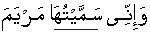
One will never find:
:
the
Personal Name of Allah the Exalted as first noun [مضاف]
of possessive construction/genitive phrases.
The
fundamental simple features and grammar of Arabic language
vividly reflect that:
has no other denotative and connotative ascription except that
of the Proper Name.
The Grand Qur’ān
unambiguously explains in various references and contexts that this is
but Unique and Exclusively
the Personal Name of Allah the Exalted, the Sustainer Lord of all that exists.
Though no
further argument is needed in support of it being Proper Noun, but
finding that almost all the translations and exegeses have erroneously
rendered it adjectival, we will further study its use by
reference to collocating context for its recognition-classification as
Proper Noun and NOT as adjective. A habitual word
combination is called collocation.
(1)
Allah -
Ar'Reh'maan
the Exalted is to be recognized as:
.
The recognition of
Ar'Reh'maan or
Allah
the Exalted is:
such Lord who maintains Aloneness. It is interesting
that this recognition is firstly mentioned in accompaniment to the
Personal Name:
Ar'Reh'maan and then for Allah:
-
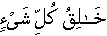
Realize it about miscellany of iela'aha:
deities that are
uncritically admired, adorned
and worshipped; none of them is alive; none of them organizes, administers or sustains others except He the
Alone Sustainer
Lord —
|
-
He is Allah the Exalted, the One about Whom the fact is: in the
miscellany of iela'aha: deities that are
uncritically admired,
adorned and worshipped; none of them is alive; none of them
organizes, administers or sustains others except He the Alone
Sustainer
Lord—
|
There is an interesting and apparent
contradiction in the psyche of those who, instead of accepting
as being the:
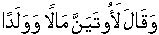
, associate other hand made/sculpted statues by
assigning them conjectural/imaginative names and declaring to their
under-influence people as their various iela'aha- the Gods, but they have never pronounced these imaginative iela'aha
as:
 Sustainer Lordof the people. The
first people of dominance, in the society and their coteries pseudo
intellectuals, who innovated the concept and idea of
various imaginative iela'aha,: godheads were "intelligent" enough not to
proclaim publicly that these so called various iela'aha had any feature of
acting as sustaining lord. Had they done it their deception could not
last long.
Sustainer Lordof the people. The
first people of dominance, in the society and their coteries pseudo
intellectuals, who innovated the concept and idea of
various imaginative iela'aha,: godheads were "intelligent" enough not to
proclaim publicly that these so called various iela'aha had any feature of
acting as sustaining lord. Had they done it their deception could not
last long.
(2)
Allah -
Ar'Reh'maan
the Exalted is to be recognized as the Sustainer Lord of peoples and of
all in the physical realm.
The recognition of Allah, Ar'Reh'maan
the Exalted:  the Sustainer Lord of the universes - all that exists.
In the
possessive phrase:
the first noun expresses a relation
based on love, care, caring, and cherishing combined with authority
and mastery of holding the subjects accountable. "Lord" is less
expressive word, therefore, it is better to render it as the
Sustainer Lord. Few Ayahs are reproduced below that indicate that
the Sustainer Lord is mentioned by Proper Nouns: Allah and Ar'Reh'maan:
-
Realize it about miscellany of iela'aha:
deities that are
uncritically admired, adorned
and worshipped; none of them is alive; none of them organizes, administers or sustains others except He the
Alone Sustainer
Lord.
|
Ar'Reh'maan the Exalted is the Sustainer Lord:
-
You the Messenger [Sal'lallaa'hoalaih'wa'salam]
pronounce, "He the
Exalted, Ar'Reh'maan,
is my Sustainer Lord.
|
-
Realize it about miscellany of iela'aha:
deities that are
uncritically admired, adorned
and worshipped; none of them is alive; none of them organizes, administers or sustains others except He the
Alone Sustainer
Lord.
|
-
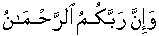
Your Sustainer Lord,
the Sustainer Lord of the Skies and
the Earth and whatever exists in between them,
is
Ar'Reh'maan, the Exalted.
|
(3)
Creator of things is identified and
referred by Proper Name, be it an individual person or a company,
organization.
We do not usually refer a creator by an adjective because a listener can
immediately ask as to who is being referred since adjectival traits
can be shared by many at a time.
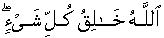
The complete perusal of Grand Qur’ān reveals that the
Names, Allah the Exalted and Ar’Rehmaan refer the Creator
of everything that exists:
-
Realize it about miscellany of iela'aha:
deities that are
uncritically admired, adorned
and worshipped; none of them is alive; none of them organizes, administers or sustains others except He the
Alone Sustainer
Lord.
|
-
Be informed;
Ar'Reh'maan,
He the Exalted
has taught the Qur’ān to the
elevated Messenger (Muhammad
Sal'lallaa'hoalaih'wa'salam) [55:01-2]
-
آگاہ ہو جاؤ)الرّحمن عز و جل نے
رسول کریم محمد (ﷺ)کوقرآنِ مجیدکی تعلیم دی ہے۔ (الرحمٰن۔۱۔۲)
|
(4) The Subject [عَبْد
plural عباد] is identified only by the
Proper Name of his Lord Allah - Ar'Reh'maan the Exalted.
The complete perusal of Grand Qur’ān reveals that
Slaves-Servants-Allegiants-Subjects are declared only
with reference
to proper Names, Allah the Exalted and Ar’Rehmaan:
-
The Slave/Subject/Allegiant of Allah
the Exalted. [refer 19:30]
-
The Slaves/Subjects/Allegiants of Allah
the Exalted. [refer 37:40]
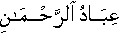
-
The Slaves/Subjects/Allegiants of
Ar'Reh'maan
the Exalted [refer 25:63;43:19]
|
|
In the days of gradual revelation of Grand Qur’ān the rational people
paid more attention to the substance and avoided indulging in discourses
and discussions about grammar and morphology etc. Moreover, such things
are of interest and necessity for a non-native/non Arab. In addition, the claim in the Grand
Qur’ān is that it is easy for
comprehension and understanding of humanity irrespective of language
barrier. It is thus evident that even without knowing the depth and niceties of
language, grammar etc one can grasp the substance and essence of the
message merely by acquaintance of Arabic.
Therefore, without delving deep into the debate spread over thousand of
pages, we plainly keep asking the Grand Qur’ān to make us understand
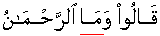
whether:
is
the Personal Name of our Sustainer Lord or is it His Attributive Name
reflecting His infinite mercifulness.
It is our common perception and approach that
whenever we introduce or mention a slave/servant or subject we do not say, "he-so
and so is slave or subject of "merciful
 ",
"powerful
",
"powerful
 " etc. On
the contrary, we refer the Personal Name of his master/Lord. Similarly,
the relationship between the Person and the thing is that of Creator and
the created. Creator is the Lord []
of the created things and the created things are the slaves [
" etc. On
the contrary, we refer the Personal Name of his master/Lord. Similarly,
the relationship between the Person and the thing is that of Creator and
the created. Creator is the Lord []
of the created things and the created things are the slaves [ ]
of their Creator. Both the words reflect a two-way relationship.
]
of their Creator. Both the words reflect a two-way relationship.
In the like manner of our perception and practice, Allah
never referred
about His slaves/created living persons [] with relation to His attributes. He
the Exalted always calls them as:
by Personal Name.
Grand Qur’ān is a discourse of Proven
Facts; the First
 :
allegiant
mentioned in the Grand Qur’ān is
Muhammad
Sal'lallaa'hoalaih'wa'salam. About 550-600 years before his corporeal appearance, Easa
alai'his'slaam
had informed about him as the Only Messenger to appear after his natural death
and mentioned at that point in time:
:
allegiant
mentioned in the Grand Qur’ān is
Muhammad
Sal'lallaa'hoalaih'wa'salam. About 550-600 years before his corporeal appearance, Easa
alai'his'slaam
had informed about him as the Only Messenger to appear after his natural death
and mentioned at that point in time: "His name is Ahmad" [61:06].
Beginning is with the Personal name:
of Allah the Exalted and immediately after
beginning/creation is:
"His name is Ahmad" [61:06].
Beginning is with the Personal name:
of Allah the Exalted and immediately after
beginning/creation is:
 "The Infinite Glory and Praise stands specified eternally, entirely and
exclusively for Allah"; and for
the one who praises someone intensively and extensively it is said that
"The Infinite Glory and Praise stands specified eternally, entirely and
exclusively for Allah"; and for
the one who praises someone intensively and extensively it is said that
 his name is
 .
.
Grand
Qur’ān is in absolute chronological sequence exposing facts relating to
temporal and pre-temporal era. The perception and concept of:
 is
not something that could exist in isolation. It can emerge only when
there is an Object for it and another person of will and intellect to act
as doer/subject of performing it. There has to be the Praised One and
the Praiser/Admirer when:
the
Praise, the Admiration will become a reality. The First
-the
Slave-the Allegiant-the One at the service of Allah is
Muhammad
Sal'lallaa'hoalaih'wa'salam, the great creation.
is
not something that could exist in isolation. It can emerge only when
there is an Object for it and another person of will and intellect to act
as doer/subject of performing it. There has to be the Praised One and
the Praiser/Admirer when:
the
Praise, the Admiration will become a reality. The First
-the
Slave-the Allegiant-the One at the service of Allah is
Muhammad
Sal'lallaa'hoalaih'wa'salam, the great creation.
The words:
 -
-
 can never appear as the first noun of possessive phrase -
أَلإضَافَةُ
ٱلْحَقِيقِيَّةُ
with second noun which is adjective/descriptive word. That will be
invalid phrase in Arabic. This fact also reconfirms that:
Ar’Rehmaan is the Proper Noun.
can never appear as the first noun of possessive phrase -
أَلإضَافَةُ
ٱلْحَقِيقِيَّةُ
with second noun which is adjective/descriptive word. That will be
invalid phrase in Arabic. This fact also reconfirms that:
Ar’Rehmaan is the Proper Noun.
(5)
Prostration-obeisance is before and
for the
Person, and not for his traits.
One pays obeisance, and gesture of extreme adoration and
submission is made before and for the Person or object referred by
Proper Noun, and not by adjectival names/traits. The concept of
Obeisance and Prostration is embedded in Arabic Root: س
ج د
. The original meanings are the feel of
lowliness, humility, submissiveness by one for someone else, which is
manifested by lowering of one's head in the state chin moving towards
chest along with eyes going downwards, or bending oneself down. The basic perception unfolds that this is a
relational word-it happens or takes
existence only when there are two entities. Moreover, evidently it is not an
abstract or theoretical proposition but a physical act; something
expressed, conveyed, and submitted through body language instead of verbal
expression. This act signifies and
demonstratively portrays-parallels one's thought of surrender and
submission reflecting acceptance of his relative humble state and
position as against the exalted, honoured, elevated stature, and glory of other. This gives us its initial perception and
meanings as obeisance, homage, respectful, saluting gesture and
behaviour
towards/for
someone else.
The relational aspect, physical nature and the
reflection of the relativity in stature, position and elevation of the
subject and the one for whom this act is done is explained at first instance of use of this Root in
the Qur’ān:
-
He
(Ieb'lees) considered it not worthy of his dignity and ego
—
|
- While he (Ieb'lees) Self
obsessed-puffed with delusion of grandeur and superiority
aspired aggrandisement.
|
The relational aspect is
conspicuously evident, that one is the performer and the other is the one
for or before
whom the act is performed. The sincere
feel and passion, paralleled by the physical gesture of body parts bowing,
reflects wilful and affectionate acknowledgement of the greatness,
grandeur and superiority of the one for
or before whom one demonstrates it. The essence, or the
inherent consideration for the performance of this act, at one's own
inclination, before or for someone is
to seek his attention, acknowledgement, and thereby become nearer to the
exalted.
The act of Ieb'lees and his
state of mind, when he demurred to comply with the command, further
reflects the denotation of the act signified by this verb. He was obsessed/puffed with pride of grandeur and superiority. What
impression and message is conveyed, and is gathered by onlookers
watching this
physical gesture, body language? It is quite vividly disclosed by
quoting the plea/so called logic of Ieb'lees for holding himself
back in paying obeisance for Adam
alahissalam:
Notwithstanding that Ieb'lees
is perhaps the first pseudo-intellectual;
his understanding of exposure and manifestation, which is caused by:
 "you pay obeisance",
discloses the essence embedded in this bodily act-gesture-body language. It is visibly
concrete exposure of feel and acceptance of relative humility,
smallness, less importance, and inferiority in state, position and
honour than the one whom obeisance is paid. He, in his own assessment,
weighed himself as superior/better than the one whom he was asked to pay
obeisance. Therefore, he did not find it befitting to pay obeisance to
the one whom he thought inferior to his self. His support argument and "logic" for presuming
himself superior, indicating that rather he is more deserving to be
paid obeisance, was the base material of their respective creation.
He did not become a reverent for the one
whom Allah the Exalted dignified and honoured upon him. This is
reflective of his act:
"you pay obeisance",
discloses the essence embedded in this bodily act-gesture-body language. It is visibly
concrete exposure of feel and acceptance of relative humility,
smallness, less importance, and inferiority in state, position and
honour than the one whom obeisance is paid. He, in his own assessment,
weighed himself as superior/better than the one whom he was asked to pay
obeisance. Therefore, he did not find it befitting to pay obeisance to
the one whom he thought inferior to his self. His support argument and "logic" for presuming
himself superior, indicating that rather he is more deserving to be
paid obeisance, was the base material of their respective creation.
He did not become a reverent for the one
whom Allah the Exalted dignified and honoured upon him. This is
reflective of his act:
 "he
made his own self obsessed/puffed with pride of grandeur
and superiority".
"he
made his own self obsessed/puffed with pride of grandeur
and superiority".
It thus conspicuously reveals
that it signifies the state of mind, i.e. the feel
precedes the gesture - its expression by body language.
The Root has been used at other occurrences also where the relational
field restricts its meanings to its basic-initial signification, i.e.
feel of humbleness with head down on chin in humility posture.
The Root and the Word; on entering in the
relational field when the Revered is the Only One-The Absolute-The Only
Independent-The Self Subsisting-The Creator-The Supreme
Exalted-Sovereign Sustainer Lord of the Universes, and the Reverent are
all objects and living-all that exists in the created realm, denote meanings from beginning to its
exhaustive-absolute limit. Beginning is the
recognition of elevated stature, grandeur, honour, glory, that serves as
stimuli for someone to submit in humility and praise, compelling him to
compromise his self esteem by bending downwards for or before another
Entity. The intensity of the recognition
and feel will get reflected from respectful and submissive posture of
lowering the head with chin going towards chest to the last exhaustive
limit of bending, lowering and surrender reflected by the forehead
placed for and before someone on Earth. Moreover, it reflects acceptance
of one's limitations/limitedness as against the self-feel of grandeur and
self-sufficiency.
Since this is a physical act, therefore, the cause or
the feel, which is its stimuli, can either be sincere, affectionate,
reverence oriented, or because of
compulsion of coercive circumstances forcing one to surrender and bend
in humility:
-
However, their shadows make themselves in prostrate
posture for Allah the Exalted, at occasion of the mornings and
the evenings. [13:15]
[Note: Prostration Ayah; please prostrate-it gets man nearer to Allah
the Exalted-96:19]
|
-
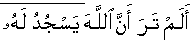
Have you not given a thought that in
fact Allah the
Exalted is the only One for Whom whoever is living - existing in the Skies and
in the Earth makes his self acknowledge and submit humbly in surrender, and
will make himself acknowledge and submit humbly in surrender, [in a state of
wilful and affectionate acceptance with reverence, and so under
compulsion of coercive circumstances —[13:15]
|
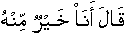
If we skim the Divine Discourse we will not find that the
prostration collocates with any adjectival - epithetical word. Apart
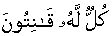
from Proper Noun Allah the Exalted, it is stated to prostrate for:
:
(6) One is mentioned
by Personal Name who adorns the Throne/Seat of
Sovereignty; and not by adjectives.
It is our common perception and a well-known
practice that we mention the Name of the person who takes over
and adorns the seat of power-sovereignty/throne. We do not mention him
by adjectival traits and attributive names. Likewise, in Grand Qur’ān only the Proper Name, Allah and Ar'Reh'maan
is mentioned with regard to adorning the Sublime Seat of
Authority-Sovereignty Who is its Sustainer Lord. Moreover, it is beyond
limits of seven skies of our Universe. This is above water.
(7) A person makes a promise. Promise-maker finds mention
by title or personal name.
A promise, commitment, undertaking, and obligation are
that of a person/being. The Title or Personal Name always refers him
with reference to the promise made by him. We never refer a promise by
the adjectival trait/attributive names of the undertaker of that promise
and commitment.
-
Allah the Exalted has promised.
(ref 4:95; 5:9;
9:68;9:72;24:55;48:29;57:10)
-
Ar'Reh'maan
the Exalted
has promised (refer
19:61;36:52)
-
your Sustainer Lord promised
(refer 7:44)
-
The promise of Allah
the Exalted. (ref 4:122;
10:4;10:55;13:31;18:21;28:13;30:6;30:60;31:9[31:33;35:5;39:20;40:55;40:77;45:22;46:17)
|
|
(8)
An agreement, contract, covenant, pact
is with reference to party's Title or Personal Name.
A contract, bond, covenant, in legal parlance, creates an
obligation which is binding upon the parties thereto. The essentials of
a contract are the parties who have legal capacity to make a contract
reflecting mutual assent. In general, contract may be oral or written. It is thus evident
that the contracting parties shall find mention by respective Title or
Personal Name. Its very nature prohibits that the reference of the
parties shall not be by adjective/attributive names. In Arabic, the
equivalent word is
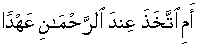
 .
.
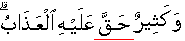
The attributive names of Allah the Exalted never find mention
in the Divine Discourse with
reference to semantic field of this word denoting something enjoined,
solemn pledge, contract, obligation, binding commitment, covenant. Its
mention is in relation only to Proper Nouns:
and
.
-
Know it,
Our Majesty will order on
the Day of Requital to bring towards
Ar'Reh'maan the Exalted; with
protocol of a delegation coming to call upon the Sovereign Lord,
those who sincerely endeavour
to attain salvation; [19:85]
|
(9) Mention of Permission, Authorization, and Proclamation is
always by the Name of the authority.
The grant of permission,
authorization and a notification, proclamation is by a person in
authority. The permission, authorization, notification and proclamation
find mention in writing only by reference to the Proper Name
of the concerned authority. The semantic domain for permission, authorization,
approval, announcement, declaration, proclamation the Root is
"
ء ذ ن"
, words
like
 ,
,
 .
.

With the explicit permission/consent/authorization of
Allah the Exalted.
(10)
People relate a son [very as well adopted] with Personal Name of
the one with whom they relate a son.
We relate a
son to a Proper Name and not describe this relationship by
adjectives/traits of person with whom we relate a son. It is common
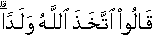
practice in all languages. Since Allah and Ar'Reh'maan
are Proper Nouns, conjectural fabrication of a son is
mentioned by these proper nouns:
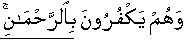
And this most erroneous palaver is also associated with
the Personal Name Ar'Reh'maan
(11)
The Unitary Verbal Passages and other signs are related to Allah and
Ar'Reh'maan,
the Exalted; not by adjectival noun - epithet.
-
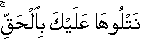
Our Majesty are reciting them distinctly, word by word,
upon you the Messenger [Mohammad
Sal'lallaa'hoalaih'wa'salam]
conveying the infallible fact - for determined purpose of
transcription by you to humanity.
|
(12)
Awe is
associated with Allah the Exalted as well with other proper name: Ar'Reh'maan.
-
Know about those people who
experience awe of their Sustainer Lord—they
behave with alertness, gentleness, subtlety, delicacy, compassion and sympathy—[23:57]
|
The Root of verb:
 is
خ ش ى. The Root is used for two converging meanings,
awe and dread. Emotion of awe is a mixture of wonder and fear - feeling of amazement and respect mixed with fear that
is coupled with feeling of personal insignificance or powerlessness.
is
خ ش ى. The Root is used for two converging meanings,
awe and dread. Emotion of awe is a mixture of wonder and fear - feeling of amazement and respect mixed with fear that
is coupled with feeling of personal insignificance or powerlessness.
The
optical
faculty is the source for the people to experience awe by the
awe-inducing nature scenes all around them
reflecting the Divine providence and Will evidently.
It is positive feeling of being in the presence of
something vast that transcends our understanding of the world.
Experiencing
awe is fundamental emotional response
of those who mindfully observes the environment and the universe they
live in.
Every particle in the universe is awesome that transcends us to the
perception of the existence of its Creator, Allah - Ar'Reh'maan
the Exalted. This gives us the feeling of "small-self"; not in relation
to awesome manifestations in nature, but in relation to our Mighty and
Sublime Sustainer Lord,
Allah - Ar'Reh'maan the Exalted.
Some other references:
-
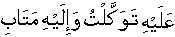
Thereat, you say, "I have
vowed to
exercise refrain/restraint exclusively
for
Ar'Reh'maan, therefore, I will not
converse with any person today." [19:26]
|
We have noticed that the Divine Discourse is explicitly
explicative. It was the lapse of exegetes who blindly followed and
copied the erroneous thought of their forerunners, pseudo-scholars George Sale and John Rodwell, by rendering a Proper Noun in the very first Ayah of Divine
Discourse as adjective.