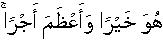
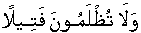
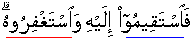
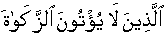
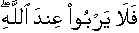
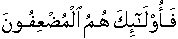
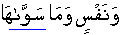
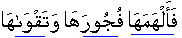
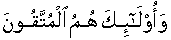
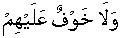
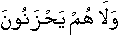
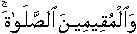
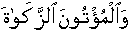
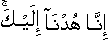
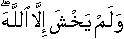
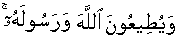
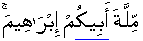
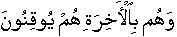
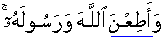
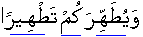
:
The financial liability upon subjects of a state for economic uplift of society.
:
The financial liability upon subjects of a state for economic uplift of society.
Responsibility and
function of Islamic State
In State of the Believers the State policies and
behaviour of individuals with regard to material wherewithal needed for
sustaining and pleasures of life must be governed and oriented according
to the
injunctions of Allah the Exalted, prescribed in Grand Qur’ān,
which were initially enforced when Allah the Exalted granted an independent
State to His elevated Messenger:
Our subject of study is financial obligation of the subjects
towards Islamic State and State's right for its collection to administer and
uplift the society. The extent of obligation imposed upon individuals for
spending for the benefit of others is prescribed:
-
You people be aware:
That whatever wherewithal you have gained - earned, valuable of any
sort which was earlier not possessed by you, thereat,
a fifth (twenty percent) of it
(newly accrued valuable) is
due to apportion for Allah the Exalted and the Messenger [Muhammad
Sal'lallaa'hoalaih'wa'salam]: i.e. Islamic state
—
Root:
خ م س
|
Contents
1. Introduction: Linguistic semantics: the study of meanings
as inherent at the levels of words, phrases, sentences and larger units of
discourse-text.
2. Perception and meanings infolded in Root: "ز ك و"
3. Propositional and connotative meanings of
Word
[not term]:
used 30 times with fiscal connotation as a sub-set of semantic-frame:
 Spending. It is obligatory fiscal contribution for sustaining and
uplifting Muslim State: the only taxation instrument.
Spending. It is obligatory fiscal contribution for sustaining and
uplifting Muslim State: the only taxation instrument.
4. Propositional and connotative meanings of other words made from
this Root in the text of Grand Qur’ān.
1. Introduction
Linguistic Semantics is the study of meanings as inherent at the levels
of words, phrases, sentences and larger units of discourse-text. It is
used for understanding human expression through language. The
discourse-text of Grand Qur’ān is in Arabic:
a
perspicuous, eloquent, distinctive and precisely expressive
language;
the language of the sons of soil of Arabian Peninsula.
Each Root has specific, defined,
distinct, conspicuous and apparent concept, phenomenon, perception and signification folded in it.
It is the source, the reservoir of knowledge. Roots can be termed as "repertory
of frames" of Arabic language if we follow frames approach to semantic analysis.
Words
originating from these Roots on various well defined
patterns-moulds-structuring frames
retain the original
perception; infolded
in the Root,
dominantly and
conspicuously, in whatever semantic field they are used.
Additional meanings and connotation, shades and colours
get added to the perception-concept-meanings infolded in the Root by the peculiar pattern-placing of vowels-syllabification
and addition of consonants.
Moreover, relational aspect of the semantic
field will also influence and add connotations to the word.
Hence;
the meanings,
perception and connotation of an Arabic word is the composite whole of the perception infolded in its Root, coupled with meanings associated
with its pattern, and its relation to the semantic field where it is used.
It signifies that
the basic meanings of a Root and word do not exhaust when they are used
in a different semantic field, relational area, while necessarily
retaining the base meanings.
2. Perception and
meanings infolded in Root: "ز ك و"
Learned Ibn
Faris [died 1005] stated the perception infolded in it in these words:
|
يدل على نَمَاءٍ
وزيادة
That it leads to the
perception of growth, thriving and increase, augmentation.
|
Lane's Lexicon
translated its basic signification from classical Arabic lexicons:
|
"it
signifies Increase, or augmentation,
it received increase and blessing from God; it throve by the blessing of God;
(Er-Rághib); It was, or became, pure: some say that the root
denotes purity: and some, that it denotes a state of increase, or augmentation;
it is said of seed-produce, and of wealth, or cattle, and of other things: of
anything that increases, or augments.
|
Evidently,
this Root has inherent evaluative meaning or connotation.
All the words emanating from this Root will have Propositional meaning as well
connotative meaning in context. The propositional meaning
of a word or an utterance are relational; it arises from the relation
between it and what it refers to or describes in a real or imaginary world. It
is also called Denotative meanings: It refers to meaning which is
referential, objective and cognitive.
Expressive meaning "relates to the speaker's feelings or attitude rather than
to what words and utterances refer to". Connotative meaning "is the communicative value an
expression has by virtue of what it refers to, over and above its purely
conceptual meaning."
3. Propositional and connotative meanings of
Word
[not term]:
used 30 times with fiscal connotation as a sub-set of semantic-frame:
Spending. It is obligatory fiscal contribution for sustaining and
uplifting Muslim State: the only taxation instrument.
Experts suggest that it is useful to view the vocabulary of a language/text as a set of
words referring to a series of conceptual fields. In linguistics, these
divisions are called Semantic fields. A semantic field or
semantic domain is a set of words grouped by meaning referring to
a specific subject; languages will have fields of distance, location,
size, shape, time, emotion, beliefs, economics, academic subjects, natural
phenomena, etc. Each field can have many sub-divisions or lexical sets:
actual words and expressions. Semantic fields are arranged
hierarchically, going from the more general to the more specific.
Linguists generally refer the general word by umbrella term "superordinate" and the
specific word as "hyponym". The
propositional meaning carried by a general word or superordinate is part
of the meaning of each of its hyponyms but not vice versa. Each Arabic Root is
specific to a semantic field referring to a specific subject.
The semantic field about Sustenance:
livelihood, means for supporting life, its necessities and comforts is
introduced very early in Grand Qur’ān by superordinate:
 :
sustenance; worldly resources for necessities and comforts of life; and:
the spending.
:
sustenance; worldly resources for necessities and comforts of life; and:
the spending.
All the hyponyms-lexical sets relating to
the main concept of Sustenance that includes everything from eatables to
all means and resources for life and its comforts and pleasures will
contain the propositional meanings inherent in the words:
and
the spending of a part of the sustenance. The characteristic of:
the sustenance is that it is the grant of Allah the Exalted. Man has the
option and discretion upon its spending. This sentence:
 ,
recurring six times ((1)2:03(2)8:03(3)22:35(4)28:54(5)32:16(6)42:28=6)
portrays the philosophy, ideological foundation of the entire economic
system of the Believers of Grand Qur’ān who have conviction in the
phenomenon of continuation of life in the Hereafter. Their economic
considerations are not restricted to the present day life but they worry
more about the economics for the ever living life.
,
recurring six times ((1)2:03(2)8:03(3)22:35(4)28:54(5)32:16(6)42:28=6)
portrays the philosophy, ideological foundation of the entire economic
system of the Believers of Grand Qur’ān who have conviction in the
phenomenon of continuation of life in the Hereafter. Their economic
considerations are not restricted to the present day life but they worry
more about the economics for the ever living life.
Grand
Qur’ān is
described by various epithets that declare it a discourse wherein every
important word is rendered explicitly explicative so that the reader
conveniently comes to
terms with the Word of Allah the Exalted, relayed by the uniquely elevated
universal Messenger
Muhammad
Sal'lallaa'hoalaih'wa'salam.
It also defines and explains the terms it has employed in its text.
Propositional/Conceptual
meaning (sometimes called 'denotative' or 'cognitive' meaning) of important
words can be ascertained in the text by what features it possesses, and also by
implication negative; by what features it does not possess. Meanings of words
are also rendered explicit, void of ambiguity, by the collocates. It consists of
the associations a word acquires on account of meanings of words which tend to
occur in its environment, the words with which they are likely to co-occur or
collocate.
What is the difference between a
word and a term? A word is usually defined as
a complete meaningful element of a language.
All terms are words, but not all words are
terms. A term is
a particular definition of a
word, which is applicable to a special situation.
Terms occur only in the process of
communication. They occur when the writer tries to avoid ambiguity and a reader
follow his use of words.
The word:
is the first word that occurs in Grand Qur’ān as a sub-division or lexical set
of semantic domain:
the spending.
It is made from Root: ز ك و
conveying perception of growth, thriving and increase,
augmentation. It seems a very strange type of spending that increases and
augments the resources while in everyday life experience spending results in
consuming of resources for yielding of life-energy, comfort, happiness and
satisfaction.
:
It occurs for the first time as the direct object of an Imperative Verb. Imperative sentences comprise of words that carry a
meaning which is understood by the majority, making the meaning almost universal.
These sentences make a command. Command by the Sustainer Lord of the Worlds is
but the Law to be complied with. Its compliance is obligatory for all the
subjects except if exemption is explicitly given to someone.
This is the command
addressed to Posterity of Iesraa'eel
[alahissalam].
Performance of both the acts were an article of their Covenant, they were
bound by, in their entire history before revelation of Grand Qur’ān:
[** This Article was amended and modified through
the Last but one elevated Messenger Easa alai'his'slaam
to read only one Messenger after his death-61:06.]
This protocol was prescribed in
timeline for the People of the Book: Jews and Christians and others as is
disclosed in following Ayahs:
-
He
(infant Easa [alai'his'slaam)
spoke to them, "I am, in fact, the Allegiant- Subject of Allah the Exalted
—
|
-
Furthermore, He
the Exalted has enjoined upon me
regards performing
Ass-sa'laat: Time
Bound Protocol of Servitude and allegiance,
and for paying Az-zakat: financial liability for uplift of society, as long I am alive.
[19:31]
|
It is thus evident that both:
 and word:
were common words for the inhabitants of Arabian peninsula.
These were neither
terms nor words which were being introduced for the first time to the audience
of Grand Qur’ān.
Those who became believers were directed in the same words about
it:
and word:
were common words for the inhabitants of Arabian peninsula.
These were neither
terms nor words which were being introduced for the first time to the audience
of Grand Qur’ān.
Those who became believers were directed in the same words about
it:
-
And
you people willingly pay Az-zaka'at:
financial liability for economic uplift of society.
|
The command for maintaining As-sa'laat: Time
Bound Protocol of Servitude and allegiance; and
for willingly paying Az-zaka'at: financial liability
for economic uplift
of society were in place before the injunction of confronting the
war imposed upon the believers:
-
You the
Messenger
[Sal'lallaa'hoalaih'wa'salam]
pronounce that the worldly sustenance-life is of a short while, limited
nature, and the Hereafter is far better for the him who remains cautious,
heedful and mindful of Allah the Exalted;
|
The word that mostly
co-occurs with:
is:
which
always takes precedence in sequence. This pair occurs 26 times. The
verbs that occur for them are respectively from Verbal nouns:
 to heartily and with ease give
away something rendering it associated to others; and verbal noun:
to heartily and with ease give
away something rendering it associated to others; and verbal noun:
 :
to establish, maintain. Twice these Possessive Phrases are used in
Qur’ān:
:
to establish, maintain. Twice these Possessive Phrases are used in
Qur’ān:
 ;
;
 .
.
Both these words:
and
have an element-feature of sociality. Sociality is the fundamental characteristic-dimension of
the created realm, matter and life both. The par excellent social activity is the socialization of the
Subject with the Lord-King-Sovereign. The affectionate Sovereign is he
who affords opportunities to his subjects to be in his presence
occasionally for sometime for paying homage and seeking blessings of
him. The subjects gain strength, feel of security and confidence by
being in the House of the Sovereign. It becomes subject's pride.
We as social beings living in societies and states are
well aware of the protocols of Subject-Lord contact. Timings are
determined by the Lord. The Subject is required to follow the prescribed
dress code and manners of speech and gestures while in the premises of
Lord. Universe is the State of the Sustainer Lord of all the
created realm and we are the resident subjects of it. The Sustainer
Lord, Allah the Exalted has prescribed and made it mandatory for us to
contact Him everyday at intervals. This is called in Arabic:
 :
The time bound Protocol of Servitude and
Allegiance.
:
The time bound Protocol of Servitude and
Allegiance.
The other most fundamental sociality is living in a geographical unit as
society. Society or state is the sum of social relations among group of
humans. The society or state despite being an abstract noun is in
fact a "living" entity. It needs to be sustained and governed. Governance needs
financial/fiscal support from its subject-constituent members. It is an
obligation upon the subjects of the society/state for sustaining it
internally and for preparedness as directed in Ayah 8:60 to deter the
enemy of Allah the Exalted and the believers by raising
combat force, strength-deterrence and a force of cavalry-mobile troops.
This obligation is denoted by the word:
fiscal obligation for sustaining and uplifting the society.
When the believers become sovereigns of a
state the first two obligations and duties upon them are to manage
institutionalization of the Time bound Protocol of Servitude and
allegiance; and willingly contribute to finance the State.
Thus:
is
the primary fiscal instrument for the upkeep of Islamic state, in modern
terms it is the taxation system of Islamic state.
There can be polytheists in
the land that has become a Muslim state; such of them are condemned who
do not pay:
the contribution for managing the state:
-
Therefore, you people transform yourselves to take stand and Path towards Him; and incline yourselves to self-accountability
to seek bucketing, protection, forgiveness of Him the Exalted for
lapses/omissions.
|
Except the Word:
:
fiscal obligation upon the subjects for the upkeep of state, there is no
other authorization in the Grand Qur’ān by reference to which the
Muslim State could subject its citizens to taxation.
The fundamental requirement for a person
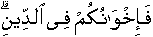
to become brother of Muslim fraternity is prescribed:
-
Sequel to this measure
if they revert (to their ancestor's Code of Life: Islam), and maintain
Ass-sa'laat:
Time bound protocol of servitude and allegiance to Allah the
Exalted;
and pay the Az-zaka'at:
financial liability for economic uplift of society
[they are brethren in your System of Life-9:11]
—
|
:
It is fiscal obligation upon the subjects for the upkeep of Muslim state
which enforces and implements
Ad-Deen: Universal Constitution:
System of Law: Operational-Conduct Code determined by Allah the Exalted, the
Supreme Sovereign and Lawmaker for all that exists called Islam:
submission to the discipline establishing orderly state of peace, security, tranquility,
harmony
and dynamic balance for all. This obligation is to be discharged for
seeking approval and appreciation of Allah the Exalted and for its
recompense in the life of Hereafter. They will gain cumulative dividend
in the truly living life in the Hereafter. It is informed:
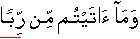
This Ayah manifests for us the difference between
Propositional-Denotative meanings and expressive meanings of words and
expressions.
Expressive meaning "relates to the speaker's feelings or attitude rather than
to what words and utterances refer to". The basic
proposition and the essential feature referred by both the words:
 and
is
increase, augmentation, growth, enlargement, accumulation. With regard
to propositional meaning and intended effect of:
,
it is not the case in the consideration and evaluation of Allah the
Exalted. It is like scum and dross of no worth in the consideration,
evaluation and judgment of Him the Exalted. Similarly, the propositional meanings of:
are synonymous to:
but the apparent effect is that it
relatively diminishes the fiscal position of its payer. But in the
evaluation and judgment of Allah the Exalted, its dictionary meanings
are genuine and true. It is a unique spending that enhances the economic
worth of a man but for his life in the Hereafter.
and
is
increase, augmentation, growth, enlargement, accumulation. With regard
to propositional meaning and intended effect of:
,
it is not the case in the consideration and evaluation of Allah the
Exalted. It is like scum and dross of no worth in the consideration,
evaluation and judgment of Him the Exalted. Similarly, the propositional meanings of:
are synonymous to:
but the apparent effect is that it
relatively diminishes the fiscal position of its payer. But in the
evaluation and judgment of Allah the Exalted, its dictionary meanings
are genuine and true. It is a unique spending that enhances the economic
worth of a man but for his life in the Hereafter.
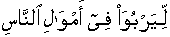
Lending money on
condition of compound interest has the intent of cumulatively increasing it
by using the wealth of other people. The propositional
meanings are thus evident showing visible increase in money given
against compound interest in the real world. This is the evaluation of the money
lender. He considers it enlargement, increase in his wealth. He may also
think it expressively as riches. But it is not an increase in the
consideration of Allah the Exalted. The same verb is used but in the
expressive meaning with co-occurrence of possessive phrase:

 in the consideration/evaluation of Allah the Exalted.
Money given with the intention
 :
that it might increase manifold in relation to worldly wealth yields what is
termed:
.
The money lenders obviously perceive themselves as
:
that it might increase manifold in relation to worldly wealth yields what is
termed:
.
The money lenders obviously perceive themselves as
 :
those who multiply the capital manifold. This is the propositional and
expressive meaning of
in consideration and judgment of a person fond of only the worldly life.
But this increase is of no worth; and is nothing but scum in the consideration
of Allah the Exalted.
:
those who multiply the capital manifold. This is the propositional and
expressive meaning of
in consideration and judgment of a person fond of only the worldly life.
But this increase is of no worth; and is nothing but scum in the consideration
of Allah the Exalted.
:
In contrast, in the consideration and judgment of Allah the Exalted, it has the
same propositional and expressive meaning as are inherent in Root "ر
ب و" and:
,
but relates to the invisible Balance Sheet of its payer. It is the final
Balance Sheet that matters and determines the social and economic status of a
person. Such payers of money to state to cope with its
economic situation are declared as truly
:
those who multiply their capital manifold. It is Active Participle: Definite; masculine;
sound plural; nominative; [Form-IV]; verbal noun
إِضْعَافٌ: an act and state of
increasing, increment. Paying money to state statistically
reduces one's financial balance in apparent worldly terms; but this
payment renders them as the multipliers of their wealth in the
evaluation and judgment
of Allah the Exalted.
Impressiveness, magnificence,
nobleness is inherent in the Root "ز ك و".
Prominence, elevation and nobleness is its natural effect, both in propositional and
expressive meanings. Grand Qur’ān highlights its
delicacy - subtlety by a contrast:
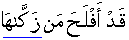
-
This is to emphasize that indeed he has attained the perpetual success
who made her Self noble,
elevated, enlightened
[above
conjectures, desires/vested interest taking guidance from Qur’ān]; [91:09]
|
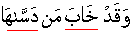
 :
A Perfect verb of this Root is contrasted with verb:
:
A Perfect verb of this Root is contrasted with verb:
 which is from Root "د س س/د س و".
It signifies concealing, or placing a thing beneath the earth or dust. The
perception and meanings conveyed by these antonyms are further evident by their
respective effect portrayed by verbs:
which is from Root "د س س/د س و".
It signifies concealing, or placing a thing beneath the earth or dust. The
perception and meanings conveyed by these antonyms are further evident by their
respective effect portrayed by verbs:
 and
and
 :
perpetual success-wellbeing contrasted with frustrating failure.
:
perpetual success-wellbeing contrasted with frustrating failure.
Infallible information, knowledge and increase in level
of understanding gives one's personality a boost, leap, rise from his
present level. His intellectual level is raised. Allah the Exalted
informs us:
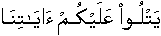
After recitation/communication of the Verbal passages of
Qur’ān the next act done by the Elevated Messenger is
 :
It is from verbal noun تَزْكِيَةٌ and is generally translated "he
purifies you; causes you to grow; he sanctifies you". Infallible
information and knowledge purifies a person in the sense that it helps
him escape the conjectural myths, false understandings and beliefs. Awareness
and possession of infallible knowledge and truths renders a man noble
and worthy. The Verbal Passages regarding sanctification and
rendering someone worthy of reward are incorporated in second part of
this paper.
:
It is from verbal noun تَزْكِيَةٌ and is generally translated "he
purifies you; causes you to grow; he sanctifies you". Infallible
information and knowledge purifies a person in the sense that it helps
him escape the conjectural myths, false understandings and beliefs. Awareness
and possession of infallible knowledge and truths renders a man noble
and worthy. The Verbal Passages regarding sanctification and
rendering someone worthy of reward are incorporated in second part of
this paper.
:
It is a possessive phrase signifying the giving of monetary contribution
for sustaining the State, willingly. All the verbs used with reference to Az-zaka'at are from the verbal noun
:
an act and state of giving, handing over the rights of possession and use to
State. The remaining Ayahs of Grand Qur’ān where it occurs are
reproduced hereunder. It will be observed that
throughout the Grand Qur’ān it is not mentioned as to who can be the
beneficiary of
which substantiates that it
is given to the State not to individuals.
-
Know you the Christians and
Jews, turnabout of your faces confronting the East and the
West is not the Virtue-Magnanimous Conduct.
|
-
On the contrary; the Virtue-Magnanimous Conduct is of that person:
Who consciously and heartily believed in Allah the Exalted and the
Last Day; and the Angels; and the Book (Qur’ān) and the
Chosen and Elevated Allegiants of Allah the Exalted
—
|
-
And he spent-donated wealth for the sake of
attaining approval and appreciation of Allah the Exalted to the
near relatives, and the father-orphans, and the destitute, and
the wayfarer, and those who seek help, and to get freedom-remission for the
slaves-prisoners
—
|
-
And he
steadfastly maintained the Institution of
As-sa'laat: Time
Bound Protocol of Servitude and allegiance;
and
he paid Az-Zakaa't;
financial liability for economic uplift of society.
|
-
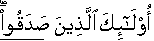
Note it; Such are the
people who fulfill their commitment - obligation when they have
bilaterally contracted
—
|
-
And they remain coolly
perseverant in crisis and financial adversity; and in times of
natural calamity.
|
-
They are the people who have proved their word-declaration of belief with their acts
as true;
|
-
And they are truly the people who
sincerely endeavour to attain salvation.
[2:177]
|
The Virtue-Magnanimous Conduct
of a person is mentioned. Firstly it is told:

 He gave-donated-granted the wealth; and
then those are mentioned to whom he gave monetary help. Then his other
action is mentioned:
He gave Az-Zakaa't.
But the recipient/s is not mentioned. This also confirms that Az-Zakaa't
is obligatory fiscal contribution for the maintenance and upkeep of
state.
He gave-donated-granted the wealth; and
then those are mentioned to whom he gave monetary help. Then his other
action is mentioned:
He gave Az-Zakaa't.
But the recipient/s is not mentioned. This also confirms that Az-Zakaa't
is obligatory fiscal contribution for the maintenance and upkeep of
state.
-
He named you
people foretimes as
Muslims: those who submit to the discipline establishing state of
peace, security, tranquillity, harmony and dynamic balance for all.
And in this (Qur’ān) too you are identified
and distinguished by this name
—
|
-
[don't feel any
offence by this address of Allah and his Messenger in 33:28 onwards,
purpose being]
Allah the Exalted certainly intends only that He the Exalted may remove
away from you all
[Messenger
and you his wives]
the brain
scattering-disconcert-fidgeting-commotion-ruckus,
O you the companions of the House,
[here singular specific house is
mentioned as against plural mentioned earlier, since the Messenger can
be in one house at one point of time, hence he and his household is the
addressee]
|
[For common believer such complete harmony in
relationship of spouses will be possible only in Paradise]
It is abundantly evident that
Az-zaka'at is
financial liability for management and economic uplift of
society/state wherein one lives. The elevated Messengers of Allah the Exalted
and their household were also subject to this taxation.
--------------------------
4. Propositional and connotative meanings of other words made from
this Root in the text of Grand Qur’ān.
Ayahs with other words made from Root:
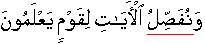
"ز ك و" used in different semantic fields





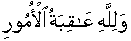




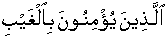
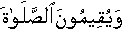

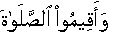
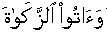

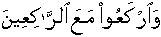

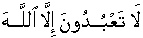
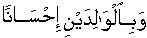

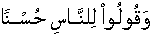


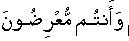






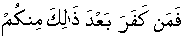

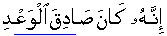
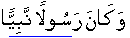
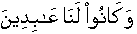
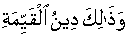
.gif)
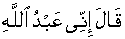



















.gif)