:
Grand Qur’ān is the best verbal discourse.
:
Grand Qur’ān is the best verbal discourse.
:
Grand Qur’ān is the best verbal discourse.
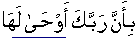
Allah the Exalted has informed about the Grand Qur’ān:
|
|
The following are relevant to the subject:
1. Grand
Qur’ān is
declared:
The best; infallibly authentic narrative conveying
information, news, episodes, history
2. Perception and meanings infolded in the Root:
"ح د ث"
of word
 :
It can be factual or fictional, fabricated.
:
It can be factual or fictional, fabricated.
3.
Major classification with reference to
source/origin of:
a verbal statement of some import;
(a) Grand Qur’ān;
(b)

 :
a verbal statement of origin other than that of
Grand Qur’ān
:
a verbal statement of origin other than that of
Grand Qur’ān
4. Classification with reference to
content-information embedded in:
a verbal statement; and author's objective of its
composition;
5.
Did Allah the Exalted
allow people to seek any:
a verbal informative statement other than the
of Him the Exalted?
6. Modes of:
 :
The act and state of transmitting:
a verbal statement with embedded semantic information:
:
The act and state of transmitting:
a verbal statement with embedded semantic information:
(a)
 : Its syllable by syllable; word by word recitation to people;
(b)
 Written down in black and white.
7.
:
A verbal statement after:
its recitation: oral transmission becomes:
 The saying comprising of articulated words that
convey
complete proposition;
The saying comprising of articulated words that
convey
complete proposition;
8. Did the exalted Messenger Muhammad Sal'lallaa'hoalaih'wa'salam
accept a single:
of multiple stories prevalent in those days?
9. Did the contemporaries: believers
and non-believers sought from the exalted Messenger some:
of his personal origin?
10. If yes, did he the exalted Messenger Muhammad
Sal'lallaa'hoalaih'wa'salam
oblige them with some:
of his personal origin-thoughts?
11. Supposedly; had he the exalted Messenger Muhammad Sal'lallaa'hoalaih'wa'salam obliged them with statements of origin other than Qur’ān what would have happened?
1. Grand
Qur’ān is
declared:
:
The best; infallibly authentic narrative conveying
information, news, episodes, history
Allah the Exalted has informed about the Grand Qur’ān:
|
|
:
It is a Possessive Phrase; the direct Object of preceding perfect verb.
:
It is Elative Noun
[اسم التفضيل];
masculine; singular; accusative; and is definite by construct. It
signifies the referred object as the best composition by all angles, dimensions and considerations;
the most appropriate; dynamically balanced; void of discrepancy,
incongruity or shortcoming.
:
Possessive Noun
[مضاف
إليه]:
Definite; singular; masculine; genitive. Its Root
is: "ح د ث"
.
Learned Ibn Faris [died 1005] explained its basic perception in these words:
(مقاييس
اللغة)
الحاء والدال والثاء أصلٌ واحد،
وهو كونُ الشيء لم يكُنْ. يقال حدثَ أمرٌ
بَعْد أن لم يكُن.
|
That it conveys the basic perception of taking existence - emergence of an affair-matter-incident-information for the first time; unprecedented. It refers an event coming into fore that had not earlier happened. |
Other classical lexicons say it is antonym of ancient. Lane's Lexicon translated the words of Ibn Faris: And حَدَثَ أَمْرٌ An affair, or event, originated: or happened, or came to pass. حُدُوثٌ is of two kinds: حُدُوثٌ زَمَانِىٌّ, which is A thing's being preceded by non-existence: and حُدُوثٌ ذَاتِىٌّ, which is a thing's being dependent upon another for its existence.
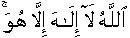
Grand Qur’ān is the only book that has built-in lexicon for its important words and terms. It exposes the perception and meanings of its important words and terms in a picturesque manner by using it in different semantic fields whereby one can perceive all its dimensions relating to substance as well accident including metaphorical aspect. It exposes the perception and meanings picturesquely also by relationships and contrasts. The basic perception and meanings infolded in the Root "ح د ث" are made conspicuously known at its very first use in the Qur’ān:
|
|
 Interrogative particle
+ Verb: Imperfect; second person; plural; masculine;
[Form-II]; Mood: Indicative
evident by نَ; and [و]
Subject Pronoun و, nominative state
+ Object pronoun: third person; masculine; singular, in accusative
state;
مصدر تَحْدِيْثٌ
Verbal
Noun.
Interrogative particle
+ Verb: Imperfect; second person; plural; masculine;
[Form-II]; Mood: Indicative
evident by نَ; and [و]
Subject Pronoun و, nominative state
+ Object pronoun: third person; masculine; singular, in accusative
state;
مصدر تَحْدِيْثٌ
Verbal
Noun.
 Verb: Perfect; Third
person; singular; masculine; active; مصدر
فَتْحٌ Verbal Noun.
Its Root is " ف ت ح"
that signifies to open, reveal, disclose. This verb used with
تُحَدِّثُونَ
has exposed the perception of Root
"ح د ث"
that it denotes to relate, tell, expose, or disclose an information
known to a person to others who are not earlier aware of it. Its
perception and meanings are also exposed when it is used last time:
Verb: Perfect; Third
person; singular; masculine; active; مصدر
فَتْحٌ Verbal Noun.
Its Root is " ف ت ح"
that signifies to open, reveal, disclose. This verb used with
تُحَدِّثُونَ
has exposed the perception of Root
"ح د ث"
that it denotes to relate, tell, expose, or disclose an information
known to a person to others who are not earlier aware of it. Its
perception and meanings are also exposed when it is used last time:
|
|
The direct object of the Verb:
 is:
is:
 : Possessive
Phrase: Noun:
Definite;
broken plural;
feminine; accusative-Root: خ ب ر + Possessive pronoun:
Third person; Singular; Feminine;
in genitive state that refers the Earth.
: Possessive
Phrase: Noun:
Definite;
broken plural;
feminine; accusative-Root: خ ب ر + Possessive pronoun:
Third person; Singular; Feminine;
in genitive state that refers the Earth.
The
verbal sentences: تُحَدِّثُونَ and
from the same verbal noun in
relation to:
and
has thus prescribed and clarified the basic perception and
meanings of Root
"ح د ث"
as the disclosure
of an information about anything or affair to
another who is earlier not acquainted with it. What is disclosed is thus:
a verbal disclosure; an informative statement about any matter, incident,
accident, affair and event.
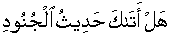
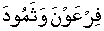
Once narrated and disclosed; it travels in time and space and is thereat described by the word "story": a factual or fictional narrative; what somebody says has happened:
|
|
|
|
|
|
|
|
It is thus evident that the
Arabic word:
signifies a verbal statement of
some import that reveals and discloses some information. Its meanings are again
made conspicuous in this informative statement about an happening in the future:
|
|
 : It is Elative Noun:
Comparative and superlative-Verbal
noun: صِدْقٌ:
Indefinite; Masculine; singular; nominative.
Its Root is "ص د ق".
Its basic perception and meanings are:
Lane Lexicon:
he spoke, said, uttered, or told, truth, or
truly, or veraciously; contr. of
كَذَبَ: Er-Rághib says that
صِدْقٌ and
كَذِبٌ
are primarily in what is said, whether relating to the
past or to the future, and [in the latter
case] whether it be a promise or other than a promise;
and only in what is said in the way of information: but sometimes
they are in other modes of speech, such as asking a question, and
commanding, and supplicating.
: It is Elative Noun:
Comparative and superlative-Verbal
noun: صِدْقٌ:
Indefinite; Masculine; singular; nominative.
Its Root is "ص د ق".
Its basic perception and meanings are:
Lane Lexicon:
he spoke, said, uttered, or told, truth, or
truly, or veraciously; contr. of
كَذَبَ: Er-Rághib says that
صِدْقٌ and
كَذِبٌ
are primarily in what is said, whether relating to the
past or to the future, and [in the latter
case] whether it be a promise or other than a promise;
and only in what is said in the way of information: but sometimes
they are in other modes of speech, such as asking a question, and
commanding, and supplicating.
 This
accusative noun is for تمييز;
disambiguation of
comparative noun.
Grand Qur’ān has
thus made it abundantly evident that:
signifies verbal informative statement about matters and affairs that may relate
to any point or period in time. Verbal informative statements can also be
publicly contradicted:
This
accusative noun is for تمييز;
disambiguation of
comparative noun.
Grand Qur’ān has
thus made it abundantly evident that:
signifies verbal informative statement about matters and affairs that may relate
to any point or period in time. Verbal informative statements can also be
publicly contradicted:
|
|

Therefore. you leave Me and him who publicly contradicts this Al-Hadith: This verbal informative discourse-breaking news. [68:44]
signifies a verbal statement of
some import that reveals and discloses some information.
A verbal informative statement is comprehended
only when a man attentively listens:
|
|

What is the reason and wrong with such people that they near not understanding and comprehending a simple informative statement that death are inevitable and results are of acts done. [Ref 4:78]




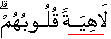
The subjection to their accountability has come nearer in time for the people. Despite its nearing, they are yet in heedlessness; they are deliberately overlooking-disregarding. [21:01]
They do not listen except hearing in a playful mood whatever warning-information comes to their notice anew quoted from the Reminder-Admonishment: Grand Qur’ān received from their Sustainer Lord. [21:02]
Their hearts are distracted and preoccupied in other trifle matters and thoughts. [Ref 21:03]
3.
Major classification with reference to
source/origin of
:
a verbal statement of some import
One of the distinct peculiarities of Grand Qur’ān is that information
contained therein is rendered
 :
This verbal noun signifies an act and
state that distinguishes and exposes the
information in a crystallized manner
by Classification -
categorization
-
individuation.
Qur’ān has classified
:
Verbal informative statement with
reference to its origin-source:
:
This verbal noun signifies an act and
state that distinguishes and exposes the
information in a crystallized manner
by Classification -
categorization
-
individuation.
Qur’ān has classified
:
Verbal informative statement with
reference to its origin-source:
|
|



Thereby, perhaps you the Messenger will be exerting too much of yourself in pursuing them for positive result upon their visible poor response;
Should they not accept-believe in this Informative Discourse: Grand Qur’ān, in a state of dismal grief. [18:06]
|
|


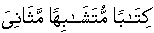
Allah the Exalted has gradually ascended-revealed the infallibly authentic breaking news and information: the best verbal discourse.
This discourse is conveyed to people in the state of a written book. It is the explainer with metaphors mirroring-bringing face to face the hidden physical facts: It is a Miscellany-cluster of Binary-Symmetrical-analogous verbal passages. [39:23]
The source of the best and the infallibly
authentic and truthful
:
verbal informative statement is that which
is revealed and communicated by Allah the Exalted to the elevated Messenger
Muhammad Sal'lallaa'hoalaih'wa'salam
in the Book: Grand Qur’ān. All other
 :
the verbal statements, whether factual or fictional are grouped as a family with
characteristic feature of their origin being other than that of Qur’ān:
:
the verbal statements, whether factual or fictional are grouped as a family with
characteristic feature of their origin being other than that of Qur’ān:
|
|


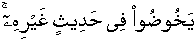

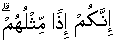


Know it; He the Exalted has certainly communicated to you people in the Book: Grand Qur’ān:
If and when you people in a company listened that the Aa'ya'at: Verbal Passages of the Book of Allah the Exalted are denied; and are jested and mocked:
Thereat, you
people should not keep sitting along with them till such time
they might start vain discussion about a
:
story;
characteristically
other than that of the Book: Qur’ān;
In case you people join them while they are jestingly and mockingly discussing Aa'ya'at of the Book then at that point in time you would apparently-sensually look like them;
Allah the Exalted will certainly gather in the Hell-Prison all Muna'fi'qeen: the imposter believers who nurture malice against the exalted Messenger; and the deniers-Non-believers, all together. [4:140]





[you the Messenger Sal'lallaa'hoalaih'wa'salam advise each individual what is sent for them in the Book-4:140] "And when you saw such people who are irrationally, vainly and jestingly debating about Our Aa'ya'at: Verbal Passages of Qur’ān:
Thereat, you are directed to stay away avoiding them till such time they might start vain discussion about a story characteristically other than that of the Book: Qur’ān;
And if the Shai'taan makes you forgetful; thereat, upon having recalled this injunction of Grand Qur’ān you should not continue sitting with the people who distort and alter the fact". [6:68]
 :
: :
It is a Prepositional Phrase; and following is a Possessive Phrase.
:
This possessive Phrase taken as adjectival
description of head noun
or grammatically as its equivalent appositive; the meanings
will not be effected. The suffixed masculine third person
singular pronoun refers to the Book: Qur’ān. Thus every
originating from any person and sources-books are grouped as
:
other than that of it: the Book: Grand
Qur’ān. Allah the Exalted has
classified the
plural of
with reference to their origin in two categories:
:
It is a Prepositional Phrase; and following is a Possessive Phrase.
:
This possessive Phrase taken as adjectival
description of head noun
or grammatically as its equivalent appositive; the meanings
will not be effected. The suffixed masculine third person
singular pronoun refers to the Book: Qur’ān. Thus every
originating from any person and sources-books are grouped as
:
other than that of it: the Book: Grand
Qur’ān. Allah the Exalted has
classified the
plural of
with reference to their origin in two categories:
(a)
Verbal statement
of Allah the Exalted mentioned in Grand Qur’ān;
(b)
:
a verbal statement characteristically of origin other than that of
Grand Qur’ān.
4. Classification with reference to
content-information embedded in :
a verbal statement; and author's objective if its
composition
Every
:
a verbal statement has composition and semantic content. Its author has an
objective and intent in composing it. Thereby, the semantic information embedded
therein
can be factual; or fictional;
a
true narration; or a manipulated, fabricated, imaginary, fictitious story or assertion.
The classification of
with reference to embedded content is also binary:
(a)
 ;
the verbal narration void of substance; playful, fascinating and conjectural
myth;
;
the verbal narration void of substance; playful, fascinating and conjectural
myth;
(b)
:
the best; infallibly authentic and truthful news and information
Grand Qur’ān describes the above classification and their purpose and effect:


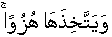
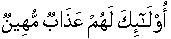
Know it; There is someone amongst the people who purposely indulges in publicizing conjectural myths and fabricated stories:
That he mighty cause neglectfulness and stray non-knowledgeable people away from the Path of Allah the Exalted; with assertions other than based on authentic knowledge;
And that he might deliberately adopt her: the Path; contemptuously and mockingly:
Such are the people humiliating punishment is prepared and in wait for them. [31:06]
:
It is a Possessive Phrase and the first noun is also definite because of
construct and is the direct object of preceding verb. It
signifies something void of substance and merely playful, amusing, theatrical
discourses and activities. His response to Qur’ān:



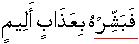
And when Our Aa'ya'at: Unitary verbal passages of Qur’ān are recited to him word by word: he turned back; in a state of mindset of arrogant self obsessed of pride;
Showing like he did not hear them; as if a heavy load is deposited within his ears: acoustic impedance is persisting in his ears.
Thereat you the Messenger announce for him "glad tidings" of painful punishment. [31:07]
:
A verbal statement is formulated by its author with a predetermined purpose and
intent. The purpose of conjecturing statements and stories is to divert
people from the Path of Allah the Exalted. The Path of Allah the Exalted is that
which is prescribed and described in the Verbal Passages of Qur’ān. The
objective of spreading conjectural stories aims at keeping people away from
Qur’ān. The extreme opposite of
is
:




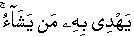


Allah the Exalted has sent in piecemeal the best verbal discourse.
This is conveyed to people in the form of a book. It is a Miscellany-cluster of Binary-Symmetrical-analogous verbal passages—It is the explainer with metaphors—mirroring the hidden realities;:
The skins of those who experience awe of their Sustainer Lord become bristled by some segment of it (Grand Qur’ān).
Afterwards, their skins and their hearts become soft and revered towards the Reminder-Reiteration-Verbal Message of Allah the Exalted: (Grand Qur’ān).
That (Grand Qur’ān) is the Guidance of Allah the Exalted.
He the Exalted guides through it a person about whom He decides to be guided.
Know it: Should Allah the Exalted let someone absorbed in indifference; engrossed in his self: thereat; there is not at all a guide for him. [39:23]
This is the verdict of Allah the Exalted:
the universal principle ever since the Man was descended from extraterrestrial
world to the Earth: that solely and exclusively the
of Him the Exalted written in the Revealed Book is the guidance.
Allah the Exalted guides people ONLY with the Words
written in
 :
The Book of Allah: Grand Qur’ān.
:
The Book of Allah: Grand Qur’ān.
5.
Did Allah the Exalted
allow people to seek any
:
a verbal informative statement other than the
of Him the Exalted?
This distinction about informative statements and pronouncements with reference to their origin and source will remain in timeline. Allah the Exalted questions the people:

Who is there more infallibly truthful than Allah the Exalted; Infallibly truthful in disclosure of breaking news; relay of hitherto unknown information? [Ref 4:87]

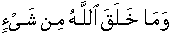


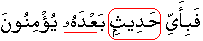
Have they not yet seen and studied the system of governance-dominion of the Skies and the Earth;
And they whom Allah the Exalted has created living out of matter?
And have they not yet considered the possibility that concluding moment of their appointed term might have come nearer?
Thereby, which public statement formulated in times after this pronouncement will they believe in? [7:185]

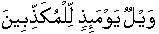


Woe-regret is the catchword on that Day for those who publicly contradict it. [77:49]
Thereby, which public statement formulated in times after this pronouncement will they believe in? [77:50]
 Possessive Phrase: Adverb of time; accusative + Possessive Pronoun: Third person; singular;
masculine; genitive state. This phrase relates to elided
adjectival description of preceding indefinite noun
Possessive Phrase: Adverb of time; accusative + Possessive Pronoun: Third person; singular;
masculine; genitive state. This phrase relates to elided
adjectival description of preceding indefinite noun
 in
absolute state [متعلقان بمحذوف صفة لحديث].
There is no denying that people formulate and fabricate stories;
and
publicize conjectural myths. They are called
in
absolute state [متعلقان بمحذوف صفة لحديث].
There is no denying that people formulate and fabricate stories;
and
publicize conjectural myths. They are called
 :
Those who manipulate and fabricate stories.
:
Those who manipulate and fabricate stories.
The
:
verbal informative statement communicated by Allah the Exalted
and made public, verbally and in writing, by the elevated Universal Messenger
Muhammad Sal'lallaa'hoalaih'wa'salam
through the Book: Grand Qur’ān will always stay distinct from
all other
:
the verbal statements that are spread in time and space:

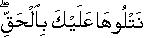
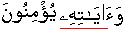

These are the Aa'ya'at: Verbal constituent passages of Grand Qur’ān, of Allah the Exalted.
We recite them distinctly word by word upon you the Messenger [Mohammad Sal'lallaa'hoalaih'wa'salam] conveying the infallible fact - for determined purpose of transcription by you to humanity.
Thereby these having reached them; which public statement formulated in times after the pronouncement of Allah the Exalted and revelation of His Verbal Passages would they believe in? [45:06]
The manipulators and fabricators of public statements have a peculiar psyche:
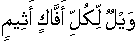



Woe-regret is the fate for every perfidiously lying sinner. [45:07]
He listens the Aa'ya'at of Allah the Exalted: Verbal constituent passages of Grand Qur’ān which are narrated to him word by word. Afterwards despite having listened the Passages of Qur’ān he remains adamant; retaining posture of obsessed of pride and grandeur as if he had not heard those.
Thereat, you give him "glad tidings" of infliction of painful punishment. [45:08]

 :
About
perfidiously lying sinners it is told in 26:222-223
that they spread-throw before people hearsay and fabricated stories.
:
About
perfidiously lying sinners it is told in 26:222-223
that they spread-throw before people hearsay and fabricated stories.
 : It is intransitive Verb: Imperfect;
Third Person; masculine; singular; [Form-IV];
Mood: Indicative; Subject Pronoun hidden; مصدر-إِصْرَارٌ
Verbal Noun. Its Root is "ص ر ر".
It signifies: The act of confining, withholding, hindering, or
preventing. He had an iron collar put upon his neck, or
round his neck and hands together. [Lane Lexicon].
Such people do not let
the words of Book access their brains as if iron collar is put around
their brains.
: It is intransitive Verb: Imperfect;
Third Person; masculine; singular; [Form-IV];
Mood: Indicative; Subject Pronoun hidden; مصدر-إِصْرَارٌ
Verbal Noun. Its Root is "ص ر ر".
It signifies: The act of confining, withholding, hindering, or
preventing. He had an iron collar put upon his neck, or
round his neck and hands together. [Lane Lexicon].
Such people do not let
the words of Book access their brains as if iron collar is put around
their brains.


And when he came to know an information anew from Our Aa'ya'at: Verbal Passages of Qur’ān he deliberately took it jestingly.
Such are the people: humiliating punishment is prepared and is in wait for them. [45:09]
 Contd: 6. Modes of
:
The act and state of transmitting
:
a verbal statement with embedded semantic information
Contd: 6. Modes of
:
The act and state of transmitting
:
a verbal statement with embedded semantic information