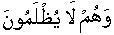
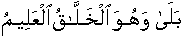
"Knowledge" is the domain of a living. A living has a
will. Thereby, he is not necessarily predictable and discoverable by
scientific rules. Matter does not possess or acquire knowledge. It can
be observed, discovered; and that system can be determined which puts the
matter to work. Thus the premises of "science" is the
acknowledgment of the fact that the universe
wherein we live is scientifically structured. Had it not in
scientifically structured state, "knowledge" and "science" might not
have been coined by human beings. Randomness and chaos would have been the
observable phenomenon all around us.
The creator of the Universe, Allah the Exalted informs:

And then tags a question about this information whether
we have as yet observed this fact or not:


-
Have you not yet observed the apparent
fact that Allah the Exalted has created the Skies and the Earth
conditioning them scientifically:
infallible governing rules for a determined purpose and time.
-
Should He the Exalted
so desires and decides: He would extinguish you people and would bring on anew
creation. [14:19]
-
Mind it, this
proposition is not impregnable upon Allah the Exalted to execute. [14:20]
 Prepositional
phrase: بـِ
Inseparable preposition + Noun: definite;
singular; masculine; genitive. This phrase is about the
elided circumstantial clause of the sentence. A circumstantial clause describes the manner,
circumstances, or conditions under which the main clause occurs.
حالcircumstantial adverb – that detail of the verb
which describes the circumstances of the subject and/or the object under
which the verb was enacted. Circumstantial expression often express nuances of
purpose or finality.
Prepositional
phrase: بـِ
Inseparable preposition + Noun: definite;
singular; masculine; genitive. This phrase is about the
elided circumstantial clause of the sentence. A circumstantial clause describes the manner,
circumstances, or conditions under which the main clause occurs.
حالcircumstantial adverb – that detail of the verb
which describes the circumstances of the subject and/or the object under
which the verb was enacted. Circumstantial expression often express nuances of
purpose or finality.
بِ
Inseparable preposition: Manner adverbial: The prep bi
can be used with a noun to modify a verb phrase by describing the manner
in which an action took place.
The Root of the object noun of preposition
 is "ح ق ق". Ibn Faris [died 1005]
mentioned its basic perception as under:
is "ح ق ق". Ibn Faris [died 1005]
mentioned its basic perception as under:
حق
(مقاييس اللغة)
الحاء والقاف أصلٌ واحد، وهو
يدل على
إحكام الشيء
وصحّته. فالحقُّ نقيضُ الباطل، ثم يرجع كلُّ فرعٍ إليه بجَودة الاستخراج وحُسْن
التّلفيق ويقال حَقَّ الشيءُ
وجَبَ
That it leads to the perception of
Primary meaning of
حَقٌّ, as explained below, on the authority of Er-Rághib,
It was, or
became, suitable to the requirements of wisdom, justice, right or
rightness, truth, or reality or fact; or to the exigencies
of the case]: it was, or became, just, proper, right,
correct, or true; authentic, genuine, sound, valid, substantial, or
real; established, or confirmed, as a truth or fact: and
necessitated, necessary, requisite, or unavoidable; binding, obligatory,
incumbent, or due: syn.
وَجَبَ; and
ثَبَتَ: it was, or became, a manifest and an
indubitable fact or event; as explained by IDrd in the Jm; (TA;)
it happened, betided, or befell, surely, without doubt or
uncertainty.
random: without pattern: done, chosen, or occurring without an
identifiable pattern, plan, system, or connection
Creating a thing scientifically necessitates the
existence of the Knowledgeable:
Science (from the Latin scientia, meaning "knowledge") usually
describes the effort to understand how the universe works through the
scientific method, with observable evidence as the basis of that
understanding; a way of understanding the world through thought and
experimentation.
The process of science is designed to challenge ideas through
research. It is not meant to prove theories, but rule out alternative
explanations until a likely conclusion is reached.
"present knowledge of the origin and evolution of the planets, stars,
stellar systems, galactic systems and the universe is pitifully small" (Encyclopaedia
Britannica, 1974, vol. 18, p. 1007).
The scientific method
When conducting research,
scientists observe the
scientific method to collect measurable,
empirical evidence in an experiment related to a
hypothesis (often in the form of an if/then statement), the results aiming
to support or contradict a
theory.
The steps of the scientific method go something like this:
- Make an observation or observations.
- Ask questions about the observations and gather information.
- Form a hypothesis — a tentative description of what’s been observed, and
make predictions based on that hypothesis.
- Test the hypothesis and predictions in an experiment that can be
reproduced.
- Analyze the data and draw conclusions; accept or reject the hypothesis
or modify the hypothesis if necessary.
- Reproduce the experiment until there are no discrepancies between
observations and theory.
Some key underpinnings to the scientific method:
- The hypothesis must be testable and falsifiable.
- Research must involve deductive reasoning, not inductive reasoning.
Deductive reasoning is the process of using true premises to reach a logical
true conclusion.
- An experiment should include a dependent variable (which does not
change) and an independent variable (which does change).
- An experiment should include an experimental group and a control group.
The control group is what the experimental group is compared against.
For a
theory to qualify as
scientific it must be:
- consistent (internally and externally)
-
parsimonious (favour of explanations relying on the fewest
assumptions)[citation
needed]
- useful (describing and explaining observed phenomena)
- empirically testable and
falsifiable
- based upon controlled, repeatable experiments
- correctable and dynamic (changing to fit with newly
discovered data)
- progressive (achieving all that previous theories have and
more)
- tentative (admitting that it might not be correct rather
than asserting certainty)
For any
hypothesis or
conjecture to be considered scientific, it must meet at least
most, but ideally all, of the above criteria. The fewer which are
matched, the less scientific it is. If it meets two or fewer of
these criteria, it cannot be treated as scientific in any useful
sense of the word.
Scientists have considered the hypotheses proposed by creation
science and have rejected them because of a lack of evidence.
Furthermore, the claims of creation science do not refer to natural
causes and cannot be subject to meaningful tests, so they do not
qualify as scientific hypotheses. In 1987, the
United States Supreme Court ruled that creationism is
religion, not science, and cannot be advocated in
public school classrooms.[63]
Most mainline Christian denominations have concluded that the
concept of evolution is not at odds with their descriptions of
creation and human origins.[64]
A summary of the objections to creation science by scientists
follows:
- Creation science is not falsifiable: The act of
creation as defined in creation science is not falsifiable
because no testable bounds can be imposed on the creator. In
creation science, the creator is defined as limitless, with the
capacity to create (or not), through fiat alone, infinite
universes, not just one, and endow each one with its own unique,
unimaginable and incomparable character. It is impossible to
disprove a claim when that claim as defined encompasses every
conceivable contingency.[65]
- Creation science violates the principle of parsimony:
Parsimony favours those explanations which rely on the fewest
assumptions[citation
needed]. Scientists prefer explanations
which are consistent with known and supported facts and evidence
and require the fewest assumptions to fill remaining gaps. Many
of the alternative claims made in creation science retreat from
simpler scientific explanations and introduce more complications
and conjecture into the equation.[66]
- Creation science is not, and cannot be, empirically or
experimentally tested: Creationism posits
supernatural causes which lie outside the realm of
methodological naturalism and scientific experiment. Science
can only test empirical, natural claims.
- Creation science is not correctable, dynamic, tentative
or progressive: Creation science adheres to a fixed and
unchanging premise or "absolute truth", the "word of God", which
is not open to change. Any evidence that runs contrary to that
truth must be disregarded.[67]
In science, all claims are tentative, they are forever open to
challenge, and must be discarded or adjusted when the weight of
evidence demands it.
By invoking claims of "abrupt appearance" of species as a miraculous
act, creation science is unsuited for the tools and methods demanded by
science, and it cannot be considered scientific in the way that the term
"science" is currently defined.[68]
Scientists and science writers commonly characterize creation science as
a pseudoscience
....................