The Qur’ān
Importance of the title of a book: Perception and meanings conveyed by the
title:
The Qur’ān
Experts and educationists suggest that the first rule in critical reading is that you must know what kind of a book is in your hand; and they say that we should know this as early in the process as possible, preferably before we begin to read. Many readers ignore titles and prefaces because perhaps they do not think it important to classify the book they are about to read. However, the author of a book facilitates its reader to know the kind of book he is being given by assigning it a title. Obviously, a descriptive and illustrative title will be considered the best for a reader to facilitate him immediately classify the book in hand.
The title of the Book we are trying to read is:
the Qur’ān:
|
|
|
|
|
|
|
|
Name of the book:
is derived from Root: "ق ر ء".
Lane's lexicon describes its perception and meanings:
" قَرَأَ الشَّىْءَ , [aor. قَرَاَ ,] inf. n. قُرْآنٌ, He collected together the thing; put it, or drew it, together; part to part, or portion to portion. [This seems to be generally regarded as the primary signification.]". This signification is mentioned in classical lexicon لسان العرب in these words:
|
The basic perception infolded in the Root is of an activity involving the process of gathering a thing at one place-point. It thus changes the scattered - separated - bifurcated - spread position of a thing into a whole; a unity. |
وقَرَأْتُ الشيءَ قُرْآناً: جَمَعْتُه وضَمَمْتُ بعضَه إِلى بعض |
The renowned lexicons say that: "قرات الناقة" means that the she-camel became pregnant. What is pregnancy? Why she became pregnant? What activity made her pregnant? The act of gathering [ ق ر ء] of the sperm and ova made her pregnant.
Another word made from this Root quoted in lexicons is
"قرء"; and its plural of abundance used in Grand Qur’ān is:
 which refers to multiple discharges
of menstruation of a woman during her period. What is
menstruation and what physical relationship does it have with the basic
perception of Rootق ر ء
? Menstruation is breaking
of the spread lining:
endometrium of the
womb [uterus in medical parlance]
which gets gathered as a whole and is discharged. Arabic Roots in their perception enfold
all the physical realities relating both
to matter and life.
They verbally mirror the image of visible and invisible realities and are thus
illustrative.
which refers to multiple discharges
of menstruation of a woman during her period. What is
menstruation and what physical relationship does it have with the basic
perception of Rootق ر ء
? Menstruation is breaking
of the spread lining:
endometrium of the
womb [uterus in medical parlance]
which gets gathered as a whole and is discharged. Arabic Roots in their perception enfold
all the physical realities relating both
to matter and life.
They verbally mirror the image of visible and invisible realities and are thus
illustrative.
The basic perception infolded in the Root relates to an activity; the process of
gathering, or compilation.
An activity yields a product; or creates a state; and/or
triggers another activity. When we carry out this process of gathering with
regard to letters-alphabet-syllables, words of a language on a piece of paper it
produces and yields the product, a compilation:
 a book; a compilation of written reading material placed
in a receptacle; it is the opposite of loose written papers; or shredded and
scattered state. This in turn triggers another activity: the process of reading.
a book; a compilation of written reading material placed
in a receptacle; it is the opposite of loose written papers; or shredded and
scattered state. This in turn triggers another activity: the process of reading.
Analytical reading involves breaking a text into its component parts to
understand its meanings and relate it to other text. This process again yields a
state for the reader as is signified by the Root and word/verbal noun:
.
It is gathered in his memory. This is the ultimate objective of reading a book;
receiving communication; the reader has come to terms with the Author as coming
to terms is usually the last step in any successful business negotiation.
The title:
informs and emphasizes upon the reader that it is kind of book which requires
analytical reading of utmost active undertaking.
The title has loudly informed the reader that this book is unique and exclusive in the family of books:
|
|
|
|
|
|
The Book sent and verbally communicated to the exalted
Universal Messenger Muhammad Sal'lallaa'hoalaih'wa'salam
is given the name:
 :
"The Grand Written Book-the Grand
Qur’ān". After thus the major classification of books in the world is:
:
"The Grand Written Book-the Grand
Qur’ān". After thus the major classification of books in the world is:
1.
and;
2.
All other books
are:

 "the written books
other than the
Grand Qur’ān".
"the written books
other than the
Grand Qur’ān".
We the claimants of belief must ponder for a while and count how many
books and written material []
other than Grand Qur’ān are embraced with our chests, and are
revered and considered parallel with it? The request of the pagans; not acceded by the
elevated Messenger
Muhammad
Sal'lallaa'hoalaih'wa'salam,
was nothing more than this.
Where we stand? The non believers of Qur’ān were directly asking the
exalted Messenger for a book and personal sayings other than the Qur’ān but he obliged them not.
Isn't it strange that we feel obliged and revere those who gave us books
and sayings, other than Qur’ān, attributing them to the exalted
Messenger Sal'lallaa'hoalaih'wa'salam?
We must acknowledge the information given
by Allah the Exalted in the Qur’ān that the contemporary non-believers
never alleged that the exalted Messenger had given them verbally and in
writing any statement other than that written in Grand Qur’ān. We must ponder for a while about
these facts that might help us align and orient towards the Qur’ān
which is declared as the Verbal Relay of elevated Messenger
Muhammad
Sal'lallaa'hoalaih'wa'salam.
|
|
|
|
|
|
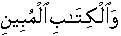
Here the explicit noun:
 is
the second direct object of the verb:
is
the second direct object of the verb:
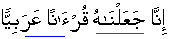
 signifies rendering, declaring, titling the Book as Qur’ān and:
 is its adjectival portrayal. Allah the Exalted has declared the title of the
Explicitly Explicative Book as Qur’ān composed in Arabic language.
is its adjectival portrayal. Allah the Exalted has declared the title of the
Explicitly Explicative Book as Qur’ān composed in Arabic language.
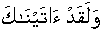
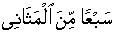
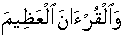
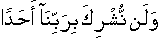
The title of the Book in our hand illustrates that all the realm, theoretical and practical, relevant to the reader is gathered and incorporated as a coherent unit in its folder: the contents; miscellany of verbal passages; the words and sentences. Allah the Exalted explicitly informs:
|
|
The title of the Book instantly reveals that which the serious listeners belonging to species Jinn had commented about it before their people; our respects and salutation to them:
|
|
|
|
|
|
|
|
It is time that we start listen the Grand Qur’ān in the manner this group of Species Jinn had listened. Listening and reading a book is treated as learning from a teacher. Listening is learning from the teacher who is present while reading is learning from one who is absent. Reading the Grand Qur’ān is thereby learning from the exalted Messenger Mohammad Sal'lallaa'hoalaih'wa'salam who verbally relayed it and transmitted to posterity by writing and compiling it as a book. His teaching to people to learn through listening and his teaching us to learn through the Book is exactly identical since he verbally narrated to them nothing but Qur’ān. He is telling us:
|

|
Allah the Exalted confirms about the elevated Messenger Mohammad Sal'lallaa'hoalaih'wa'salam that he teaches us:
|
o
|
Let us pay our respects and salutations and show obeisance to the universal Teacher and guide lord in a humble and respectful manner. This will help to elevate our selves and will place us amongst those who recognize and acknowledge the honour bestowed by Allah the Exalted on him. It will prove us distinguished and of different psyche than that of Iblees-Satan who refused to show obeisance to Adam alai'his'slaam whom Allah the Exalted granted distinction and honour over the Angels and the Jinn species.