














Course Navigator
Back To Course
Social Psychology: Homework Help Resource9 chapters | 134 lessons
As a member, you'll also get unlimited access to over



















Duane has taught teacher education courses and has a Doctorate in curriculum and instruction with a focus on the social sciences.
In a popular legend, young George Washington once chopped down a rare and valuable cherry tree for reasons which were never fully explained. When his father asked him what happened to the tree, he said, I cannot tell a lie. I chopped down the cherry tree.
This story has been handed down for many years to show that Washington was honest to a fault, and in this way he has acted as a role model for all of us. Though the concept of a role model was first given a name in the 20th century, people were familiar with the concept well beforehand.
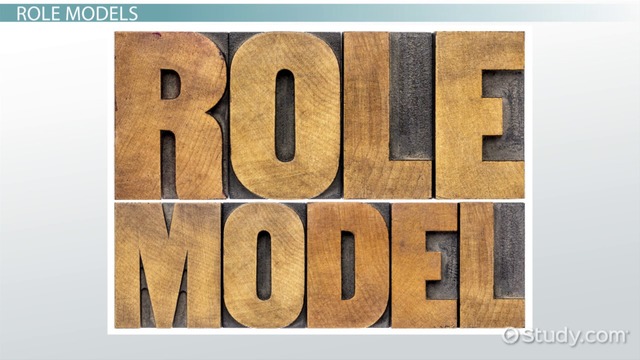
A role model is a person other people look up to in order to help determine appropriate behaviors. Role models can be either positive or negative. Positive role models offer a range of helpful or useful behaviors. Negative role models, on the other hand, offer examples of harmful or disruptive behaviors.
Virtually anyone can be a role model, but in Western culture, publicly visible figures such as athletes, actors, musicians, and celebrities are the most common examples. Other common role models include members of the clergy, police officers, and parents. Most of these people can be considered either negative or positive role models depending on their behaviors. Figures like drug dealers and gang members can be considered almost exclusively negative because of the behaviors they display.
As the sample list suggests, visibility plays an important part in making someone a role model. The most visible examples, like athletes or actors, involve individuals for whom public visibility is part of the job. Since many people can observe these individuals' behaviors, it is likely people will imitate their behaviors and attitudes. While people of all ages may have role models, it is generally young people who are still developing their own identities who try so hard to emulate their role models.
As one would suspect, social scientists continue to find the concept of role models fascinating. The term role model comes from sociologist Robert K. Merton, whose work centered on social groups. Merton discovered that rather than modeling individual behaviors, people tend to model sets of behavior. These sets of behavior are demonstrated by people who occupy certain roles in society.
Behavior sets may contain contradictory ideas that do not necessarily work well together. Instances of a role model displaying one set of ideals and then being caught living according to another set of ideals are not uncommon, and all this behavior is part of the same set. This is why people are concerned about how role models live their not-so-private lives. A role model's display of antisocial behavior may be added to the set of behaviors emulated by people who admire them. Merton's work on role models emphasizes highly visible individuals' behaviors and how people who look up to them react to such behaviors.
Another social scientist whose work is relevant here is psychologist Albert Bandura, whose work on learning led to the development of the social learning theory. Bandura found that individuals tend to be active observers of their environments. During these observations, people make note of the behaviors exhibited by others and imitate them. This imitation is part of a complex process of determining both the cause and consequence of the behavior in question. While this may sound like common sense, Bandura's work was an important step in appreciating how humans actively learn from others instead of merely reacting to their environments.
Of course social scientists find role models fascinating, but they aren't the only ones. Virtually everyone has had a role model at some point in their lives. As both Merton and Bandura would point out, they are a natural part of our environment. It is generally with young people in mind that parents, teachers and other people discuss role models. There is great concern about what young people learn from those they idolize. Public role models are often scrutinized and criticized because of the behavior they display in public. Whether this criticism is right or wrong generally depends on the behavior and how it was made public. It's a gray area whether people have a right to ask such role models to change their behavior. In any event, it's often easier said than done.
Though famous people are often role models, other people like parents, pastors and teachers can model behavior for others to emulate. In many ways, parents are the first and most constant role models available to their children.
A role model is a person other people look up to in order to help determine appropriate behaviors. Role models can either be positive or negative. Positive role models offer a range of helpful or useful behaviors; negative role models, on the other hand, offer examples of harmful or disruptive behaviors.
In Western culture, publicly visible figures such as athletes, actors, musicians, and celebrities are the most common examples of role models. Visibility plays an important part in making someone a role model. The most visible examples, like athletes or actors, involve individuals for whom public visibility is part of the job. Since many people can observe these individuals' behaviors, it is likely people will imitate their behaviors and attitudes. It is generally young people who are still developing their own identities who try so hard to emulate their role models.
The term 'role model' comes from sociologist Robert K. Merton. He discovered that, rather than modeling individual behaviors, people tend to model sets of behavior. Behavior sets may contain contradictory ideas that do not necessarily work well together. Instances of a role model displaying one set of ideals and then being caught living according to another set of ideals are not uncommon, and all this behavior is part of the same set.
Psychologist Albert Bandura found that individuals tend to be active observers of their environments, noting the behaviors exhibited by others and imitating them. This helps determine cause and consequence of certain behaviors. Bandura's work was an important step in appreciating how humans actively learn from others instead of merely reacting to their environments.
Though famous people are often role models, other people, like parents, pastors, and teachers, can model behavior for others to emulate. In many ways, parents are the first and most constant role models available to their children.
To unlock this lesson you must be a Study.com Member.
Create your account
Already a member? Log In
BackDid you know… We have over 49 college courses that prepare you to earn credit by exam that is accepted by over 2,000 colleges and universities. You can test out of the first two years of college and save thousands off your degree. Anyone can earn credit-by-exam regardless of age or education level.
To learn more, visit our Earning Credit Page
Not sure what college you want to attend yet? Study.com has thousands of articles about every imaginable degree, area of study and career path that can help you find the school that's right for you.
Next Lesson
 Explore our library of over 10,000 lessons, anytime, anywhere